Japan has spent decades pulling iodine out of salty water
Japan extracts iodine from salty groundwater beneath Chiba. Discover how decades of chemical know-how connect to perovskite solar cells and beyond.

Perovskite solar cells are making Japan’s iodine newly strategic. The deeper story is what companies in Chiba learned by extracting it for decades.
Japan’s push into perovskite solar cells has produced an oddly specific talking point: iodine. The thin, lightweight cells use iodine compounds in their light-absorbing layer, and Japan happens to be the world’s second-largest iodine producer.
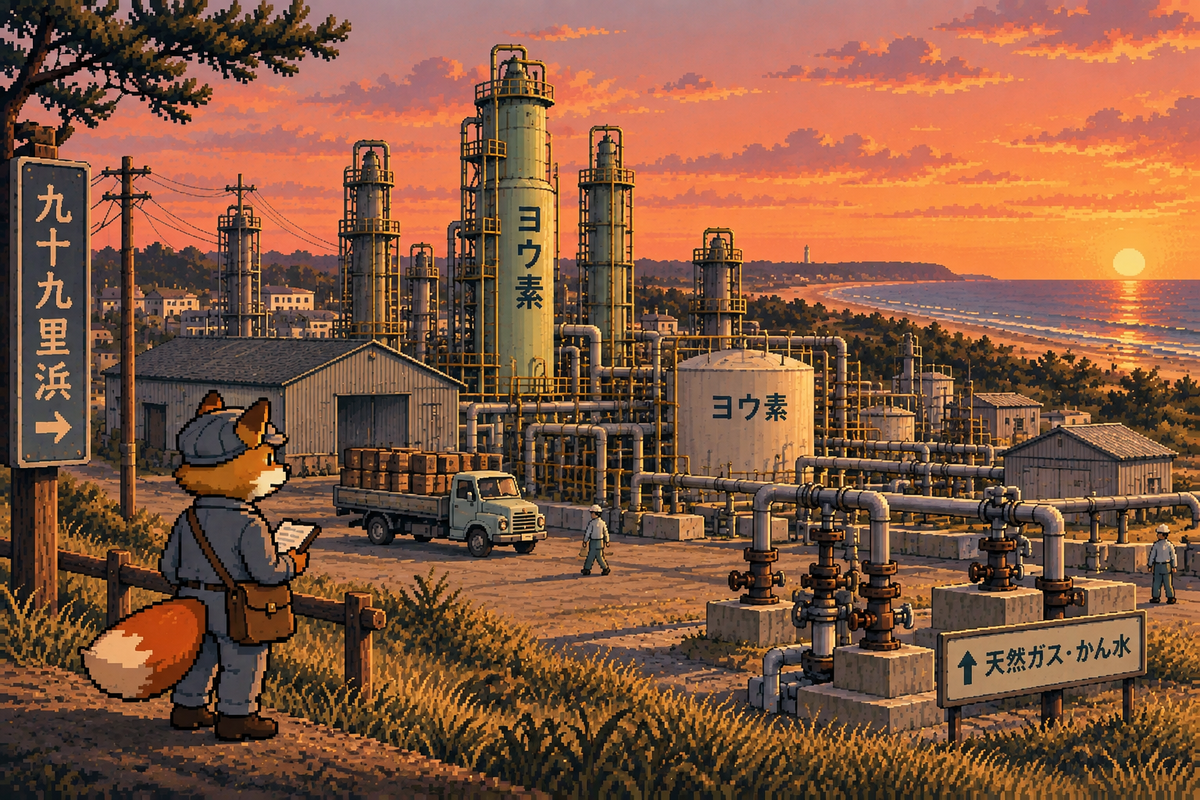
Most of Japan’s iodine comes from Chiba, particularly around Kujukuri. Chiba Prefecture says the Kujukuri zone accounts for roughly 80% of domestic production.
That sounds like a handy strategic advantage. Then you look at how much iodine the solar cells actually need.
They don’t actually need that much
A study of Japan’s perovskite supply chain, published in February 2025, interviewed companies and tried to calculate the requirement.
Japan is aiming for around 20 GW of perovskite solar capacity by 2040. The study estimated that producing enough cells for 20 GW would use roughly 100 to 200 tonnes of iodine, depending on the cells’ conversion efficiency.
Several companies interviewed for the study said they did not expect iodine itself to become a supply bottleneck. Even at 20–40 GW, the report calculated that perovskite cells would consume only around 2–4% of Japan’s annual iodine production.
So having lots of iodine is useful. It just may not be the scarce-resource advantage it first appears to be.
What makes Chiba more interesting is where that iodine comes from, and what an industry has learned from working with it for decades.
There is no iodine mine
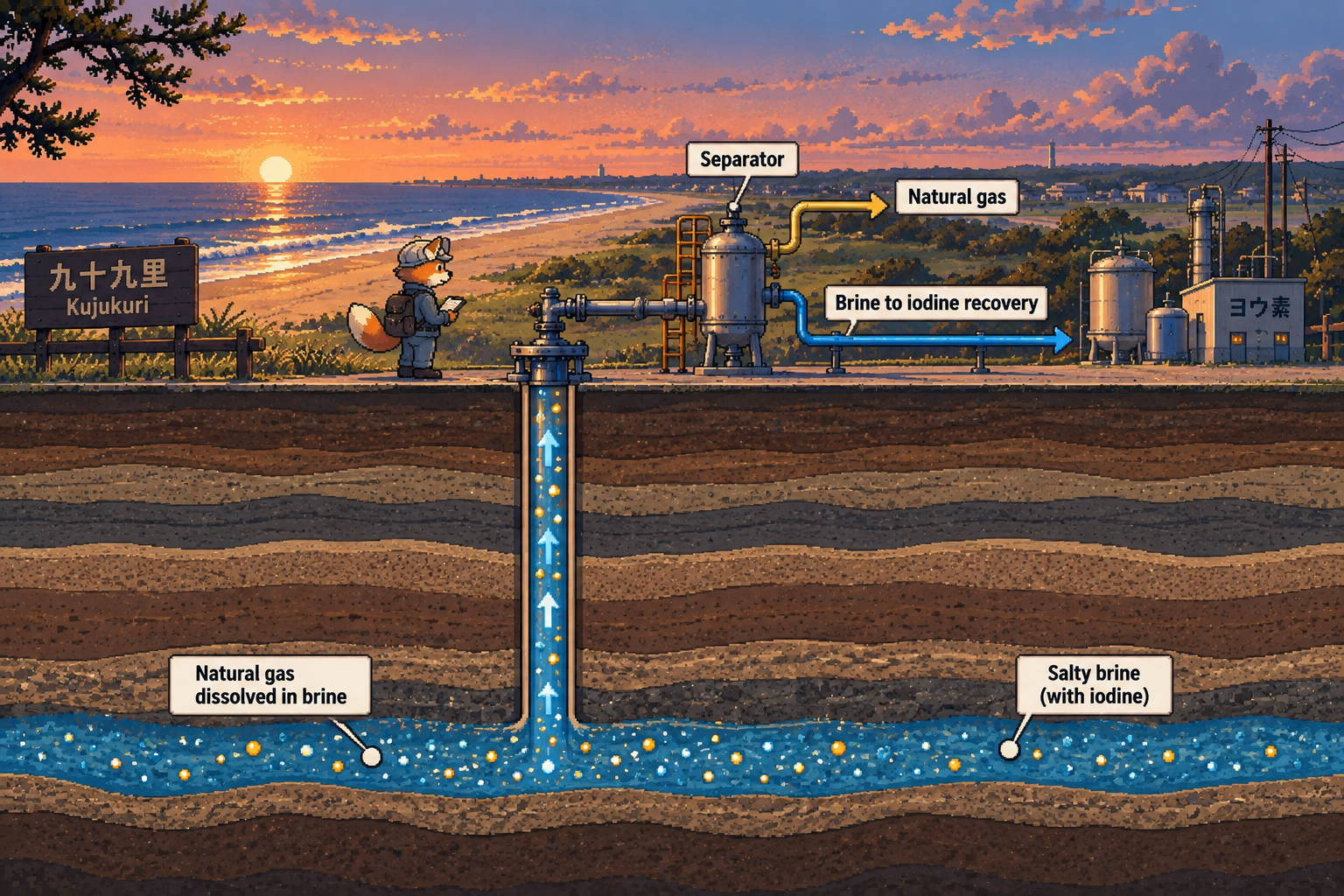
Around the Kujukuri area of Chiba, companies pump salty groundwater called kansui from the Minami-Kanto gas field, separate out the natural gas dissolved inside it, and recover iodine from the water left behind.
The iodine is still surprisingly dilute. Ise Chemicals says its brine contains roughly 0.1 grams per litre, compared with 0.0001 grams per litre or less in ordinary seawater.
One of the ways Japanese producers get it out sounds pleasingly straightforward. The brine is treated so the iodine can be separated, then air is blown through the liquid to drive it out before it is crystallised and purified.
Simply pumping more kansui is not an unlimited answer either. Chiba first signed land-subsidence agreements with natural-gas producers in 1973. The current agreement was renewed in January 2026 and runs through the end of 2030.
Eight companies are covered by it. Two of them turn up elsewhere in this story: Nippoh Chemicals and Ise Chemicals.
An iodine company from 1948 ends up in solar cells
Nippoh gives a good example of what grew above those wells.
The company began producing iodine in 1948. By 1957 it had established technology for making hydrogen cyanide, and in 1971 it adopted the blowout method for iodine production.
The useful detail is that these are not really two separate industrial histories. Nippoh was established to produce iodine from Boso Peninsula brine, while the natural gas extracted with that brine is used as a raw material for hydrogen cyanide and its derivatives.
Two useful resource streams come out of the same underground system.
Decades later, Nippoh has worked with Professor Atsushi Wakamiya’s group at Kyoto University on industrial manufacturing methods for materials used in perovskite solar cells.
A company built around salty water and natural gas underneath Chiba is now working on industrial manufacturing methods for a technology that did not exist when the company started.
That is the part I find more interesting than the raw resource.
The know-how has been travelling for decades
Ise Chemicals provides an even clearer example.
Ise established Woodward Iodine Corporation in Oklahoma in 1984. Today, Ise says it provides technology to Woodward and collaborates with it on iodine and natural-gas production in the United States.
In June 2026, Ise agreed with Select Water Solutions to expand that activity again, developing iodine production from water generated by oil and gas operations in Texas, New Mexico and Oklahoma.
Select supplies the American water infrastructure. Ise is expected to fund, design, build, own and operate the iodine extraction and refining facilities. The first commercial plant is targeted for 2027, with approximately 3,000 tonnes of annual iodine production targeted by the end of 2030.
For perspective, that is about one-third of Japan’s entire 2025 iodine production.
The iodine isn’t travelling from Japan. The extraction knowledge has been.
Back in Chiba, the recovery problem is still attracting new approaches. A much earlier-stage project called PhaseShift Technologies, currently preparing to launch as a company, is developing a way to recover iodine and other valuable resources from low-concentration industrial wastewater. Chiba Prefecture says the team is working towards tests using real wastewater; whether the approach proves commercially useful remains unknown.
The rabbit hole: back to seaweed
There is an amusing historical twist to all this.
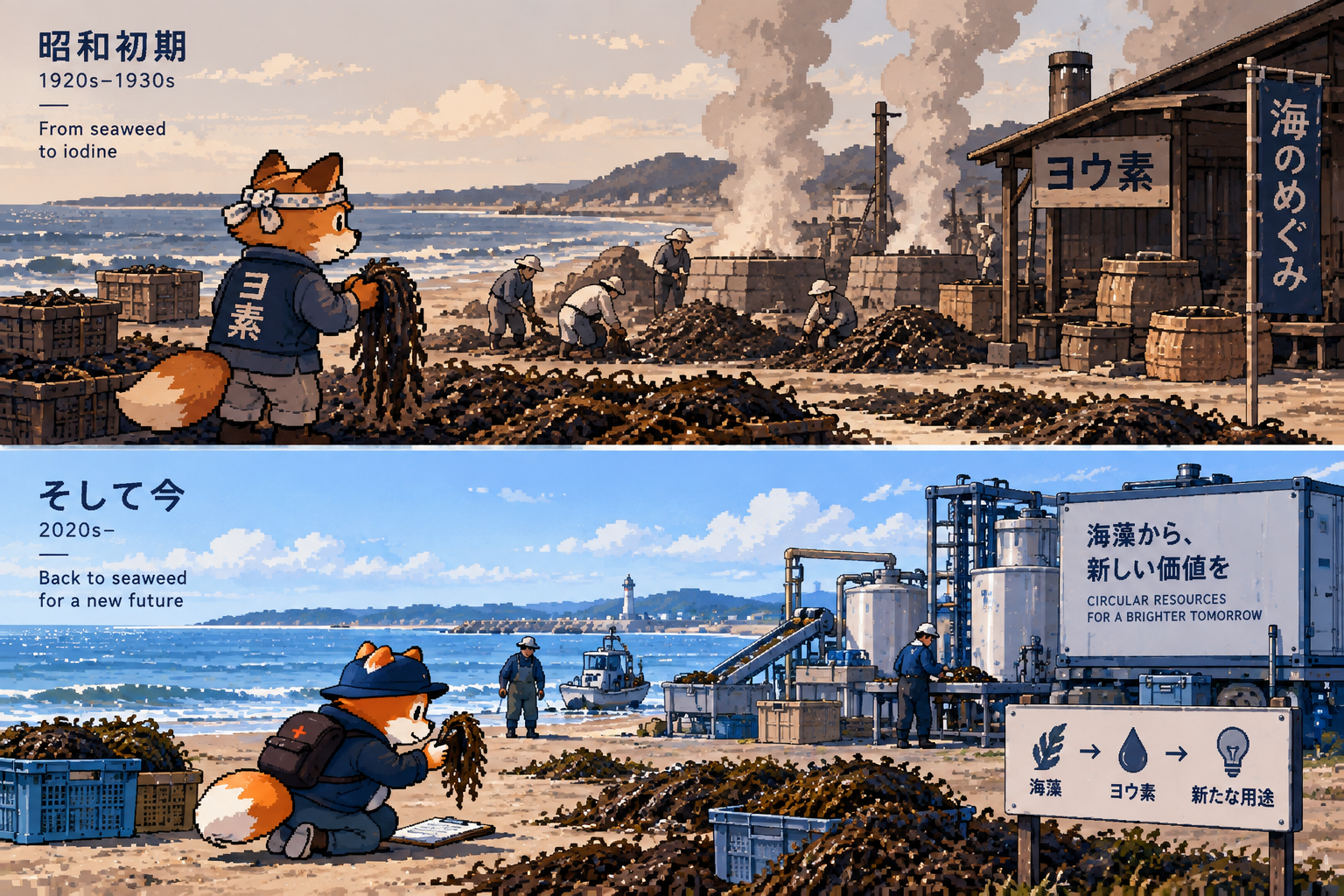
Japan did not always get its iodine from underground brine. From the 1880s, iodine was produced in Japan by burning and processing seaweed. Brine-based iodine production began in Chiba in 1935 and eventually replaced seaweed as the important domestic source.
One of the companies in this article followed that transition itself.
Ise began in 1927 in Mie, manufacturing iodine from seaweed. In 1950, it started producing iodine from natural-gas brine in Chiba. (Ise Chemicals)
The connection may run deeper still. The Society of Iodine Science gives one explanation for Chiba’s iodine-rich brine: iodine from ancient algae, diatoms and other marine organisms was buried with seabed sediments and became concentrated underground over geological time.
Now Chiba is looking at seaweed again.
A Chiba University-led project selected in 2026 is building a system to extract iodine near where cultivated and washed-up seaweed is collected. The project also wants to find uses for the organic material left behind, including functional products and pet-food ingredients.
There is no evidence yet that seaweed is about to replace underground brine as an important source of iodine.
But it creates a pleasing circle.
An industry that began with seaweed moved underground, spent nearly a century learning how to extract iodine from salty water, and is now finding itself connected to a new generation of solar technology.
And while that happens, somebody in Chiba is looking at the seaweed again.
Sources & Further Reading
U.S. Geological Survey
Current global production context. Its 2026 Mineral Commodity Summary puts Japan second behind Chile and estimates 2025 Japanese iodine production at around 9,000 tonnes.
Chiba Prefecture
Useful current context on the Kujukuri iodine industry and its roughly 80% share of Japanese production. Its land-subsidence material explains the current agreement governing brine extraction.
Japan Society for the Promotion of Machine Industry — Economic Research Institute
The key corrective to the simple iodine-scarcity story. Its February 2025 report contains the company interviews and iodine-demand calculations used here.
Ise Chemicals
A particularly useful primary source for the industry’s long arc: seaweed iodine from 1927, Chiba brine from 1950 and Oklahoma from 1984. Its iodine business page explains the brine extraction process, while its global operations page describes the technology relationship with Woodward.
Nippoh Chemicals
Its history page establishes its iodine, hydrogen-cyanide and blowout-method history. The company’s Japanese corporate page explains the connection between its brine-derived iodine and the natural gas it uses for hydrogen-cyanide production.
Kyoto University Institute for Chemical Research
Independent confirmation of Professor Atsushi Wakamiya’s project with Nippoh on industrial manufacturing methods for perovskite-solar-cell materials.
Select Water Solutions
Primary documentation for Ise’s latest U.S. expansion, including the 2027 first facility and approximately 3,000-tonne annual target for 2030.
Society of Iodine Science
A useful lay explanation of iodine resources, production methods and one proposed biological origin for the iodine concentrated beneath Chiba.
Chiba Iodine Resource Innovation Center and Chiba Prefecture
Useful for the history of seaweed iodine and the new project trying to extract iodine from seaweed again.