Tokyo Gas wants a robot that can get around the next bend

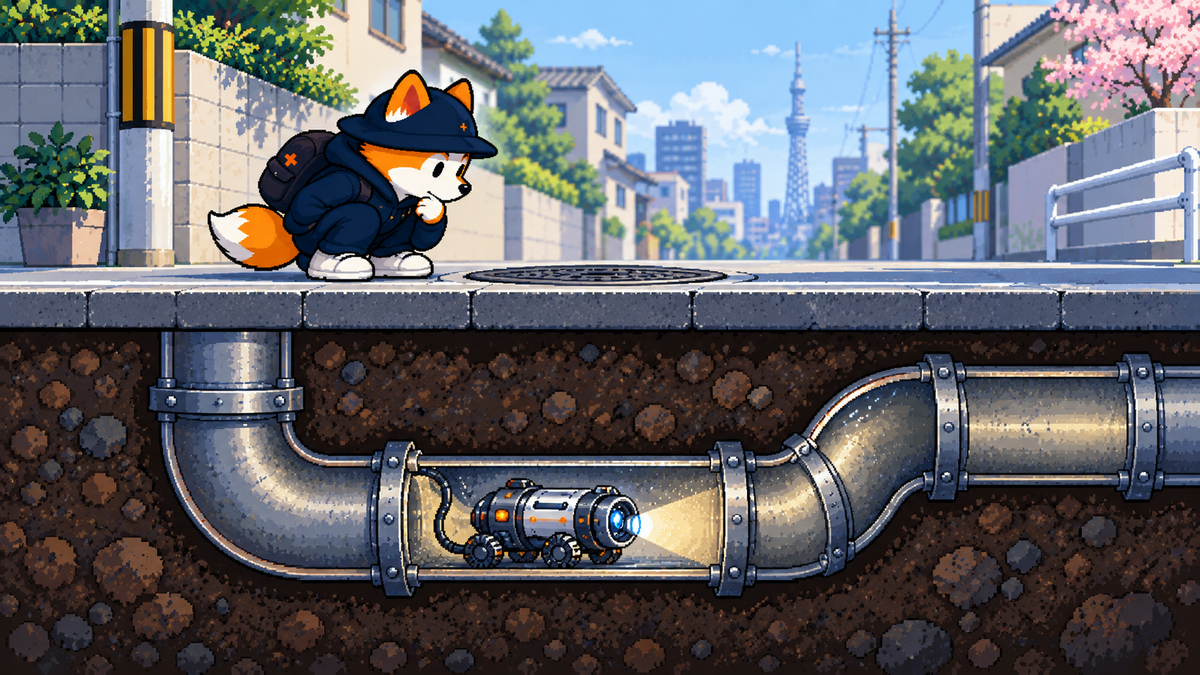
Getting a robot thirty metres through a buried gas pipe is difficult. Making it useful once it gets there may be harder.
If something goes wrong inside a buried gas pipe, sometimes the difficult part is simply finding it.
Tokyo Gas Network uses cameras to investigate problems such as water getting into its distribution pipes. But a conventional camera can only be pushed around so many bends. Once it reaches a corner it cannot pass, crews may have to dig another hole in the road and start again from somewhere closer.
Tokyo Gas Network and the University of Tokyo have been working on another approach: send the camera in under its own power.
Their jointly developed robot is designed to travel through 50A steel gas pipe for 30 metres, including an underpass section containing four bends. Tokyo Gas also set requirements including IPX7-equivalent waterproofing, operation with metal debris left inside the pipe, repeated travel through the difficult route without damage, and an explosion-proofing requirement that the robot introduce no ignition source. The company says those development specifications have been achieved.
That solves one problem. It also creates several more.
A small gas pipe becomes an obstacle course
A small gas service pipe is not a miniature railway tunnel. It contains horizontal and vertical sections, elbows, T-junctions and sockets where the available space suddenly changes.
A useful robot also has to reverse. Getting thirty metres into a pipe is less impressive if somebody has to excavate it afterwards to get it back.
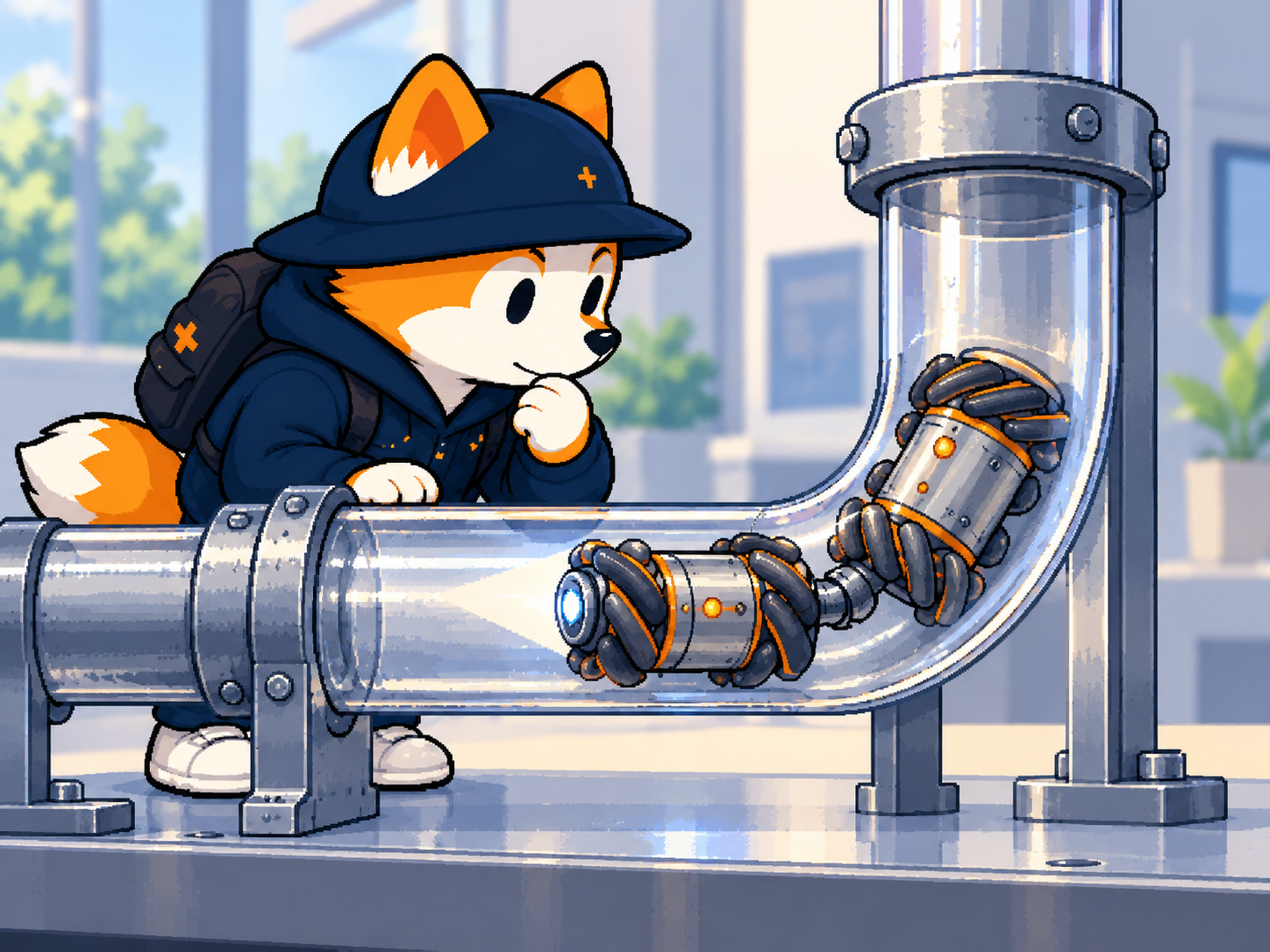
Tokyo Gas's own machine uses spiral leg-wheels. In straight sections, the front and rear wheel modules rotate in opposite directions. When the robot reaches a bend, they rotate in the same direction so the body turns into the curve. The camera image is binarised, allowing the control system to judge the bend's position and direction and adjust the robot's posture.
A later academic prototype from the same broader research lineage is called SPIRA.
SPIRA shows how much movement can be extracted from a very small mechanism. It uses three motors and twelve angled wheels, spring-loaded pantograph legs to accommodate changes in diameter and internal steps, and a single powered bending joint between its two main sections. That lets the robot negotiate straight and vertical pipe, elbows, sockets and T-junctions while still being able to reverse. The peer-reviewed paper describes the mechanism and target geometries in detail.
The principle did not begin with SPIRA. Kamezaki and colleagues had already been developing small gas-pipe robots with Tokyo Gas engineers for years.
The Tokyo Gas machine and SPIRA clearly sit in the same wider development lineage. The public evidence does not, however, establish that they are exactly the same hardware.
That distinction matters when we look at how far each has actually progressed.
A laboratory robot is not a gas-company robot
SPIRA's academic paper is useful partly because it exposes the unfinished parts.
The experiments were designed to test the basic locomotion mechanism rather than constitute a full field trial. The robot travelled through arrangements containing straights, vertical sections, elbows, tees and sockets, but the test environment did not recreate everything waiting inside an old buried steel gas pipe.
The researchers also identify further work around environmental resistance, autonomy and practical construction. SPIRA therefore shows that the mechanism can negotiate the target geometries under controlled conditions; it does not establish that this particular prototype is ready to disappear beneath a Tokyo street. The Waseda record links to the peer-reviewed IEEE paper.
Tokyo Gas's utility-oriented machine appears further along in some respects. The company says it confirmed inspection over 30 metres from one direction, including the four-bend underpass, and that its published development requirements were met. Its next stated work included improving running stability and testing in deteriorated piping.
There are limits to what that tells us. The public material does not establish that the 30-metre test took place inside a live buried gas main, and a stated explosion-proofing requirement is not the same thing as evidence of formal certification to a particular standard.
Outside a clean test arrangement, the robot still has to deal with water, corrosion, debris, uneven surfaces and uncertain geometry.
Robots have been moving through pipes for decades. Britain's Pipebots programme, for example, is a UK multi-university effort working on many of the same underlying problems: locomotion, sensing, communication and autonomous control in buried pipe networks.
There is no useful global-first claim to make here.
Then there is the cable.
Thirty metres of cable becomes part of the robot
A machine deep inside steel pipe still needs reliable power and communications. A tether pulled through several bends creates friction, and the farther the robot travels, the more the cable itself can resist its movement.
That problem has been visible in gas-pipe robotics for years. A 2019 Tokyo Gas/Waseda paper describes cable friction and wireless-signal attenuation as limits on inspection range.
By June 2026, researchers working with Tokyo Gas Network were presenting another approach: multiple auxiliary machines coordinating the feeding of the inspection robot's cable during long-distance travel. The project is listed in Kamezaki's publication record.
The publicly accessible record establishes that the work exists, but not enough of the result is available to say that the cable problem has been solved.
Even so, the progression is revealing. You can spend years inventing clever wheels to negotiate elbows and then discover that thirty metres of ordinary wire rubbing around those elbows becomes the next bottleneck.
For this kind of machine, the robot and its tether are really one system.
Finding rust by moving the light
Travelling through the pipe only gets the machine to the interesting part. It still has to recognise what is wrong.
Another project from Kamezaki's research group approaches that problem by changing the physical environment rather than immediately reaching for a more complicated AI model.
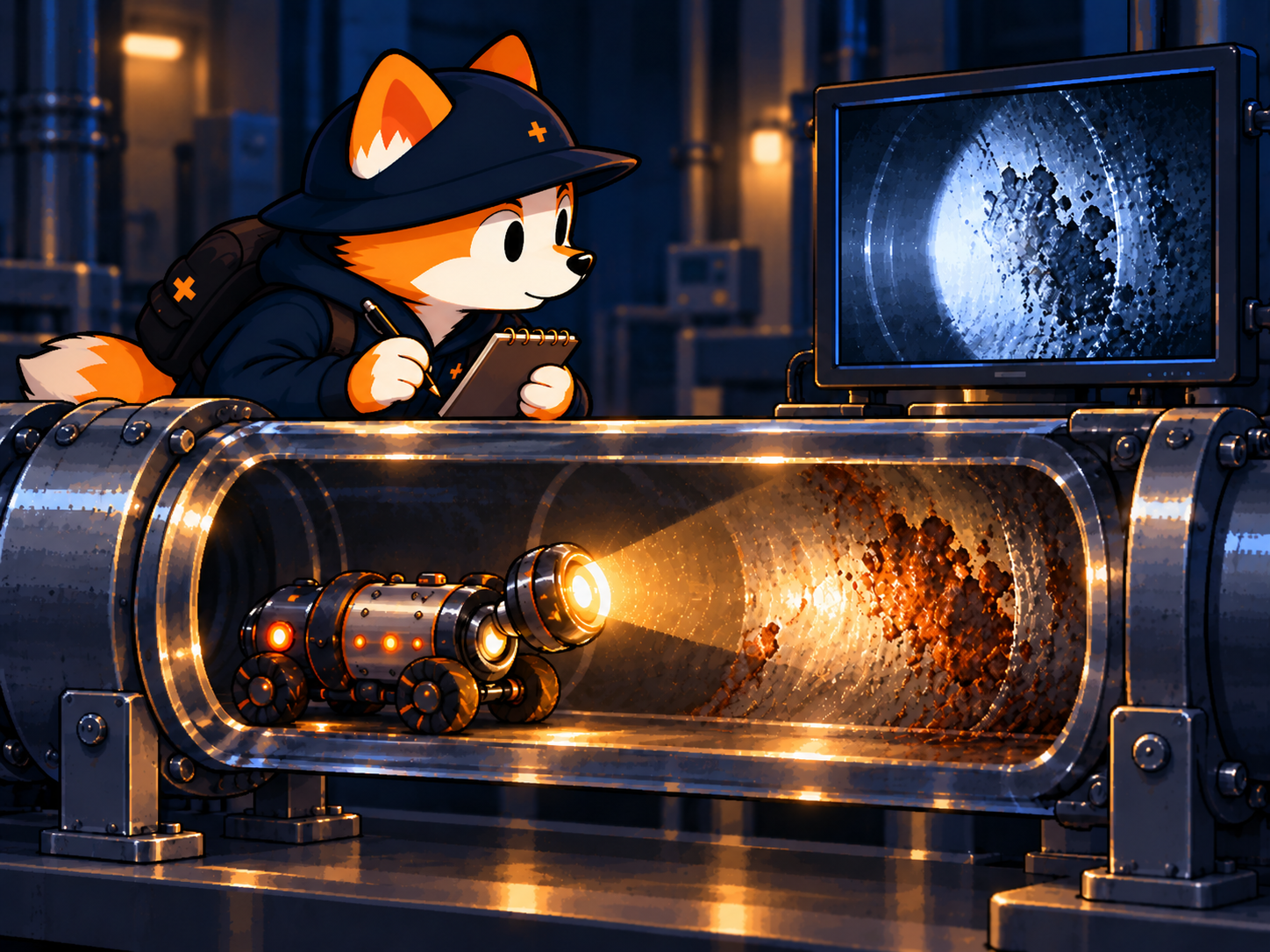
The researchers place a point light source close to the pipe wall and move it around the surface. Corrosion produces changing shadows and reflections, making suspicious regions easier for conventional image-processing algorithms to distinguish.
There is a practical reason for doing this. Deep-learning systems can work well when large labelled datasets exist. Large labelled datasets of defects inside buried gas pipes are considerably harder to collect.
The team tested the system on real corroded gas pipe and reported improved detection robustness without relying on machine learning.
Sometimes the easier way to improve machine vision is not to make the model smarter. It is to improve what the camera gets to see.
Looking eventually becomes fixing
Researchers in the same broader programme have also started asking what happens after damage is detected.
In 2025, they presented a prototype designed to press epoxy putty onto areas of pitting corrosion from inside a small gas pipe. The project appears in the official Robotics Society of Japan conference programme.
The evidence gets thinner here. Publicly accessible material establishes that the repair research exists, but not that it can yet produce durable, pressure-qualified repairs under realistic operating conditions or that Tokyo Gas intends to deploy this particular system.
For now, its significance is the direction of travel.
The objective is not really to build a robot that can crawl through a pipe. It is to make more of the pipe maintainable without repeatedly reaching it from above.
From separate tricks to a maintenance system
From July 2021 to June 2026, Kamezaki led a NEDO-backed project focused on making in-pipe maintenance smarter using robotics. His research-funding record gives the programme dates.
NEDO material from 2022 divided the problem into linked challenges: moving through the pipe, identifying abnormal locations, performing repairs, and eventually operating more autonomously and safely. At that point, NEDO described the project's progress as fabrication of an integrated system.
That date matters. The NEDO document is an early progress snapshot, not a final report. I have not found a public final outcome document showing exactly what had been achieved when the programme ended in June 2026.
Individual locomotion, perception, cable-management and repair projects are visible in the research record; that does not mean one complete autonomous maintenance machine already combines them all.
The next programme therefore arrives at an interesting point.
On 9 September 2026, JST announced 17 new A-STEP Stage II selections. One pairs Kamezaki, now at the University of Tokyo, with Tokyo Gas Network on a project described as an AI-robotics-based smart gas-pipe maintenance system. JST's formal announcement is dated 9 September.
JST has not yet explained exactly what will go into the system. The real test will be whether enough of these separate capabilities can be combined into something Tokyo Gas can actually use.
If that works, success may be measured less by the cleverness of the robot than by an excavation that no longer has to happen.
The rabbit hole: robots talking with flashes of light
There is one earlier answer to the communications problem that is too strange to leave out.
Steel gas pipes are difficult environments for ordinary wireless communication. Signals attenuate, while tethers bring their own problems.
So researchers working with Tokyo Gas tried another approach: send more robots into the pipe.
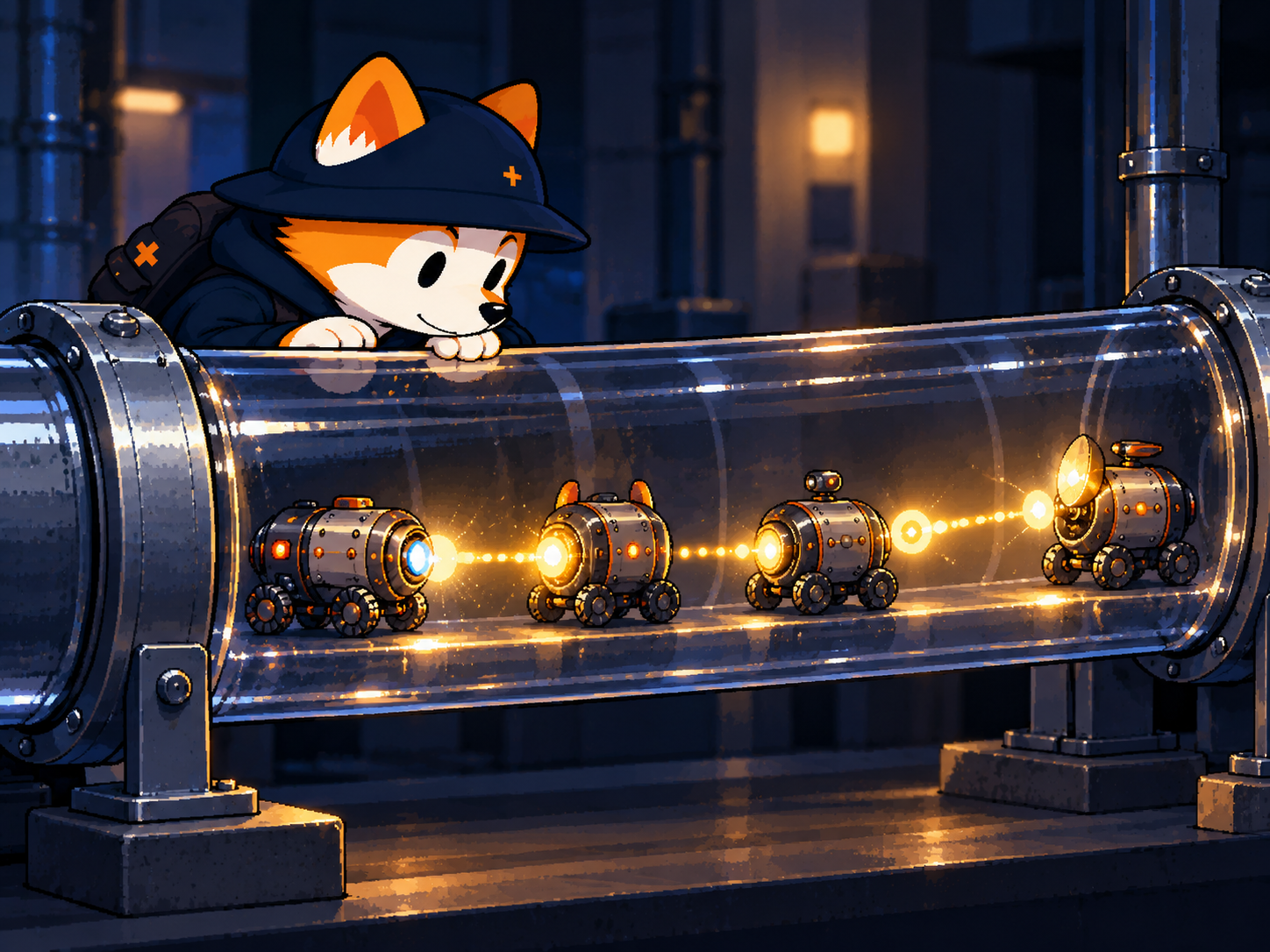
A leader robot performed the inspection while smaller follower robots positioned themselves along the route as communication relays. Instead of relying on ordinary radio, one version passed information from robot to robot using visible light.
The light did more than carry data. It could also illuminate the pipe, while the robots measured received illumination to judge whether they remained within a reliable communication range.
The maximum relay communication distance was about 3.6 metres, using two robots around 1.8 metres apart. The in-pipe tests used a 300 mm-diameter straight pipe, and the researchers explicitly identified elbows and T-junctions as future challenges. The full paper describes the setup and its limitations.
Against a target of thirty metres through a small service pipe with multiple bends, one attempt to escape the cable problem simply uncovered another set of constraints.
Years later, researchers are still wrestling with the much less futuristic question of how to manage a physical cable.
A robot can have clever wheels, cameras and increasingly capable software. None of that helps much if, somewhere after the fourth bend, it can no longer talk to anyone.
For one group of Japanese researchers, the answer was another little robot waiting in the dark for the next flash of light.
Sources & Further Reading
Tokyo Gas Network — In-pipe self-propelled robot camera
The strongest source for the actual utility problem, the nominal 50A pipe specification, 30-metre/four-bend route, development requirements, automatic bend recognition and Tokyo Gas's stated test outcome.
JST — A-STEP Stage II selections
The fresh signal: the new University of Tokyo / Tokyo Gas Network project to build an AI-robotics-based smart gas-pipe maintenance system.
JST — 9 September 2026 announcement
Dates the selection announcement and confirms 17 Stage II projects were chosen.
The best technical entry point for the later spiral-leg-wheel robot, its three-motor/12-wheel architecture and target pipe geometry.
NEDO — Smartization of in-pipe maintenance using robotics
Shows that locomotion, inspection, repair and safe/autonomous operation were being treated as parts of one maintenance problem. This is 2022 progress material, not a final 2026 outcome report.
Kamezaki Lab — Research funding
Useful for the July 2021–June 2026 NEDO project dates and the follow-on research chronology.
Waseda / AIM 2025 — Rotating-light defect detection
The strongest source for the corrosion-detection section and the rationale for changing illumination rather than depending on a large machine-learning dataset.
Kamezaki Lab — 2026 cable-feeding research
Confirms the Tokyo Gas-linked project using multiple auxiliary machines to coordinate cable feeding for long-distance robot travel. Detailed performance results are not established in the public record used here.
Robotics Society of Japan 2025 — Epoxy-putty repair robot
Confirms the repair prototype and its stated purpose. It does not establish field-ready repair performance.
Sensors — Visible-light robot-chain communication
Peer-reviewed full text for the rabbit hole, including the 3.6-metre maximum relay distance, 300 mm straight-pipe setup and stated difficulty with elbows and T-junctions.
Useful global calibration showing that miniature autonomous pipe robotics is an international research field rather than a Japanese invention.