Japan’s three-metre robot boat is getting a much bigger job
A Japanese startup is developing three-metre autonomous boats for underwater sonar missions, combining unusual hull design, robotics and maritime engineering.

Oceanic Constellations has been teaching a small autonomous boat to stay out overnight, survive the sea and find its own way home. Japan’s defense agency now wants to know whether several of them can search underwater together.
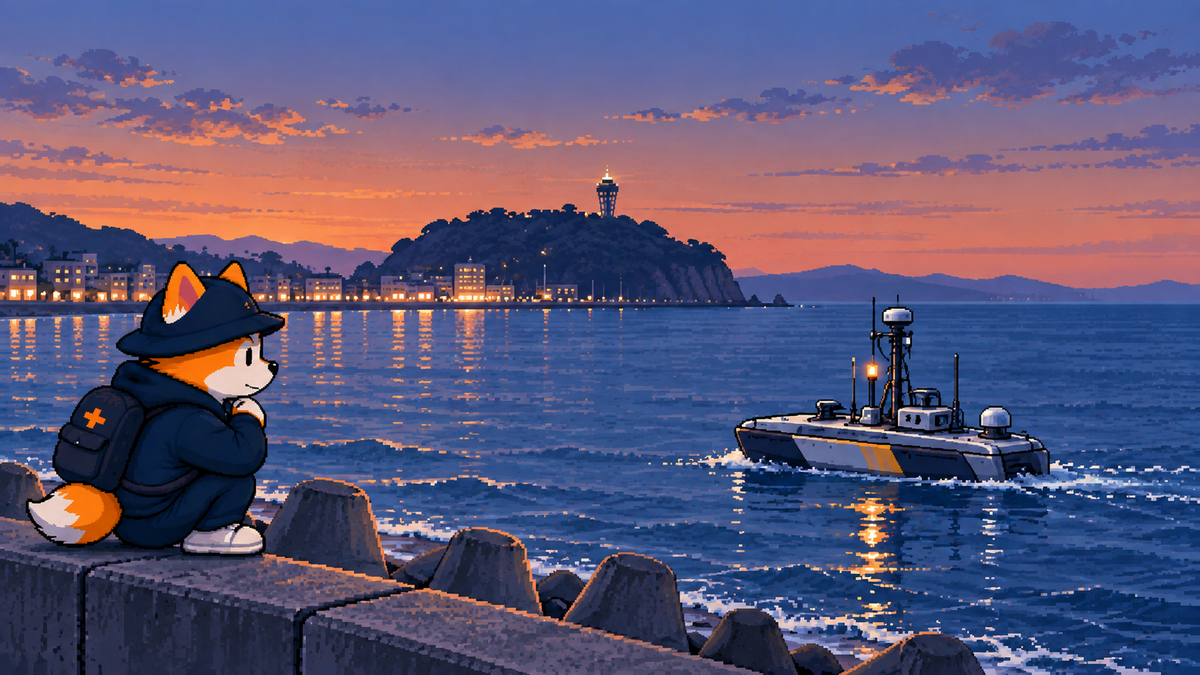
In August 2025, a three-metre electric boat spent the night patrolling the water off Kamakura. Nobody was aboard.
The boat belonged to Oceanic Constellations, a startup founded less than two years earlier. The test was part of work towards using unmanned vessels for coastal monitoring and anti-poaching. It ran autonomously for 12 hours, from 5pm until 5am.
That is not especially long by the standards of mature autonomous maritime systems. Some overseas unmanned vessels now remain at sea for months.
But the little Kamakura boat has since been given a much harder assignment.
Japan’s defense procurement agency wants Oceanic to demonstrate whether several small unmanned vessels can cooperate to search underwater. Before that becomes plausible, the company has to solve a collection of less dramatic problems: keeping a small boat upright, making enough power, avoiding other vessels and getting home without somebody waiting to grab it.
The difficult thing about leaving a robot in the sea
Oceanic Constellations was incorporated in Kamakura in November 2023. One of its earliest public projects involved using an unmanned vessel, sonar and communications equipment to help investigate possible underwater cultural remains in Yuigahama Bay. The anti-poaching work came later.
These are modest applications, but they expose the practical problems underneath the much bigger idea Oceanic is pursuing. The company wants small unmanned surface vessels, or USVs, to remain offshore for long periods and eventually operate in groups.
That is very different from sending a remote-controlled boat around a marina for an afternoon. Small vessels have little room for batteries, sensors, computers and communications equipment. Solar panels can extend endurance, but available deck area is limited. Rough seas can flip the boat, communications can disappear, and a vessel that behaves perfectly in open water still has to navigate docks, buoys and other boats when it comes home.
Japan’s Acquisition, Technology & Logistics Agency, or ATLA, identifies several of these problems itself. Its small-USV programme documents point to capsize protection, restricted payload capacity and the challenge of 365-day solar-powered operation as constraints facing vessels this small.
Oceanic’s publicly demonstrated endurance remains far short of that ambition. For now, the clearest benchmark is those 12 hours off Kamakura.
One particularly awkward problem has produced a much stranger-looking solution.
Why the boat is deliberately wonky
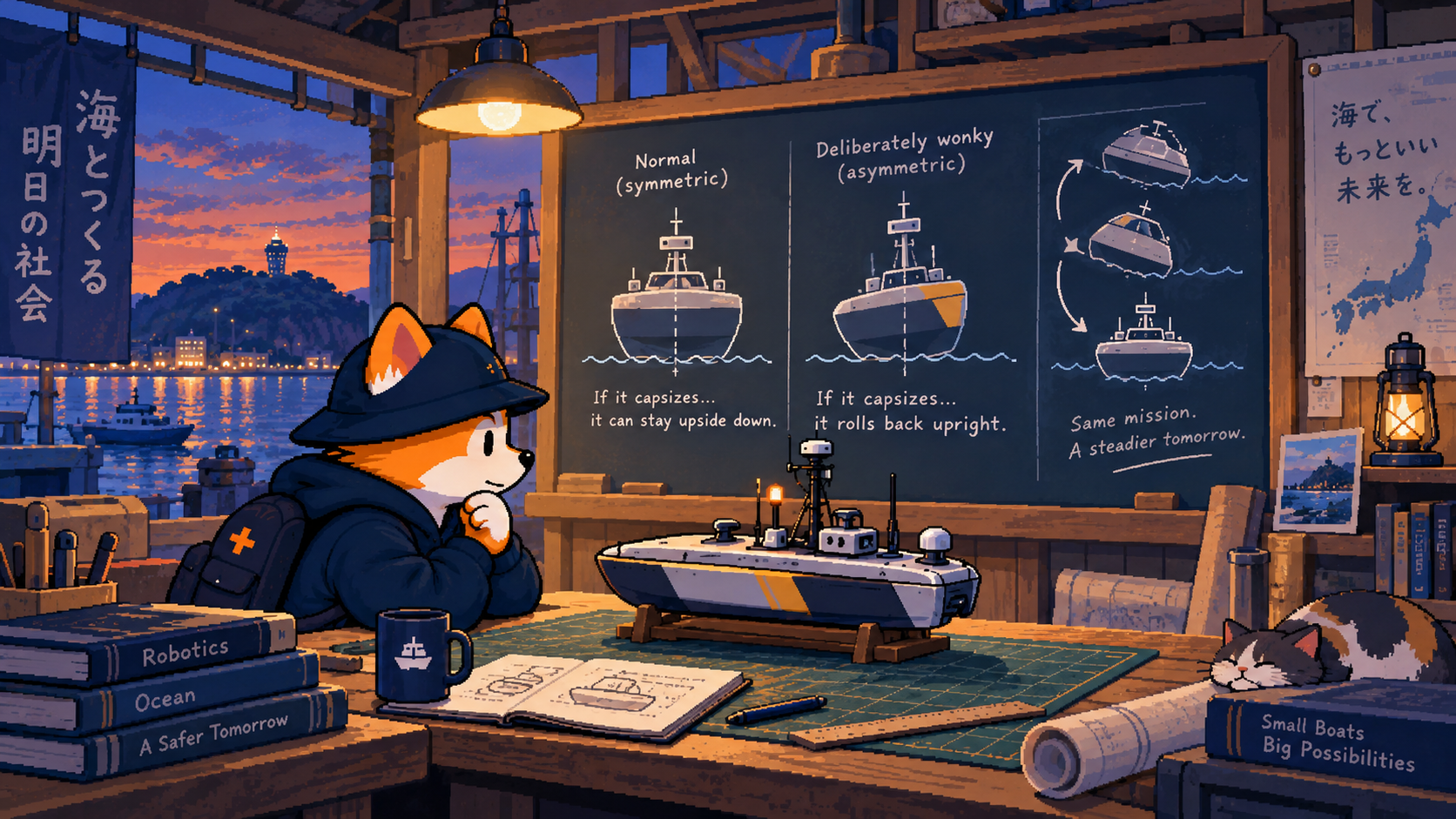
Viewed from above, Oceanic’s newer boat is not symmetrical. That is intentional.
A solar-powered vessel benefits from a broad, unobstructed upper surface because more deck means more room for solar cells. Unfortunately, a broad little boat can have another property: if a wave turns it upside down, it may be rather comfortable staying there.
Some unmanned boats solve this with a large hoop or external structure that helps force the vessel back upright. Oceanic wanted to keep the top of the boat clear, so it worked with a small Japanese naval-architecture company called ACT.
ACT’s design work traces back to Japanese America’s Cup campaigns beginning in 1993. The company says it developed its own CFD and other design tools through that racing work and later applied the same kind of computational approach to commercial vessels.
Decades later, some of that knowledge has ended up on a three-metre autonomous boat.
ACT and Oceanic designed the upper section of the hull asymmetrically. One side projects farther than the other, so that when the boat is inverted its geometry is intended to create a preferred direction in which it rolls. The underwater portion can remain broadly symmetrical for normal movement through the water while the section above it is deliberately lopsided.
ACT has tested the concept using computational fluid dynamics. In its published simulations, the asymmetric three-metre model righted itself under wave conditions in which a comparable symmetric model remained inverted.
The public evidence is simulation rather than a deliberate capsize test of Oceanic’s current vessel at sea. The boat is therefore designed to right itself, rather than publicly proven to do so under real offshore conditions.
What makes the detail interesting is the route by which the problem is being solved: the need to keep solar panels exposed on a small autonomous vessel has pulled America’s Cup hull-design expertise into a robot-boat startup.
A robot boat still has to find its parking space
Capsizing is only one way an unmanned boat can become inconvenient. Another is returning home.
If every mission ends with somebody remotely steering each boat through a marina and catching it at the dock, operating dozens of them becomes labour-intensive very quickly.
On 31 August 2026, Oceanic tested a more complete sequence off Kamakura. Its boat left its launcher, travelled towards an offshore test area, returned to the marina and entered the launcher again without an operator manually steering it.
The vessel used cameras, LiDAR and other onboard sensors. Oceanic says it did not need additional RTK-GPS equipment on the harbour side to complete the process.
Humans were still involved. Engineers and managers monitored the test from land and from a separate monitoring vessel, while controllers watched from Oceanic’s control room. During part of the outward journey, the USV detected that manned boat, estimated its position and speed, and followed it towards the test area.
So the demonstration was not an autonomous vessel disappearing offshore with nobody watching. What it did show was an end-to-end sequence in which nobody had to take over the steering.
That matters much more once the ambition shifts from operating one boat to operating many.
Someone else already has “satellites of the sea”
The idea itself is not uniquely Oceanic’s. Australian company Ocius describes its Bluebottle autonomous vessels as “satellites of the sea.”
Australia is also much further ahead. On 11 March 2026, the Australian government announced a A$176 million investment to deliver 40 more Bluebottles over five years, expanding the Royal Australian Navy fleet from 15 vessels to 55. The government explicitly describes the vessels as providing persistent surface and sub-surface surveillance.
The endurance gap is equally large. Bluebottles are already used for missions measured in months rather than hours, and Ocius says some deployments have exceeded six months. The vessels harvest solar, wind and wave energy and are designed for acoustic surveillance as well as other maritime missions.
This is no longer simply an experiment with autonomous boats.
That changes the question around Oceanic. The interesting thing is not whether somebody has thought of putting lots of persistent autonomous boats at sea before.
They have.
The more interesting question is how Japan builds its own version.
From yacht racing to a Japanese shipyard
ACT is one part of that answer. Another is Keihin Dock, a shipbuilder in the NYK group.
In October 2025, Keihin and Oceanic signed a joint demonstration agreement aimed specifically at establishing a mass-production system for small USVs. By February 2026, NYK was publishing photographs of an Oceanic vessel being assembled at Keihin Dock.
The engineering problem changes once the objective moves beyond a handful of prototypes. A startup can hand-build one vessel and keep tuning it until it behaves properly. A distributed network requires something less glamorous and much harder: repeatable production.
Keihin already has experience integrating unusual propulsion and energy systems into small ships and tugs. NYK lists projects spanning hybrid propulsion, LNG, ammonia and fully electric vessels among the shipyard’s recent work.
Oceanic says it is also working with suppliers on a Japanese electric thruster, high-efficiency solar and storage systems, control equipment and software, and other parts of the vessel. It does not publicly identify many of them.
The company building the small sonar for the defense project is also not publicly named.
The missing supplier names are part of the story.
For now, much of the industrial layer underneath the boat is still hidden.
The much bigger job
On 31 March 2026, ATLA signed a ¥498.9 million contract with Oceanic Constellations for a technology demonstration involving multiple small USVs and multistatic sonar. The official contract value is ¥498,880,635.
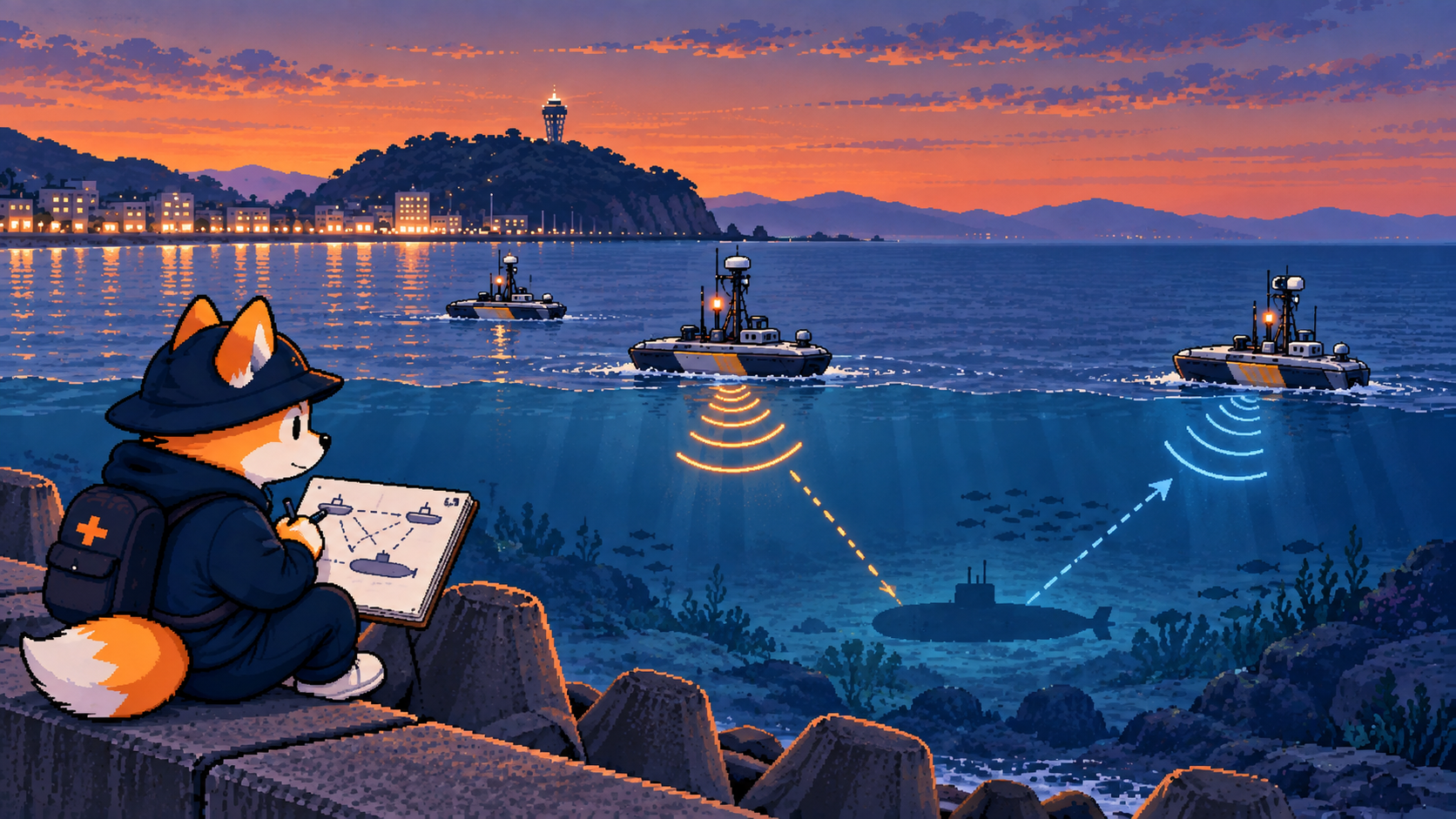
The terminology sounds more complicated than the basic idea. Active sonar sends sound into the water and listens for reflections. In a conventional monostatic arrangement, the transmitter and receiver are effectively in the same place.
Multistatic sonar separates them. One platform can transmit while another, somewhere else, listens for the returning signal. With transmitters and receivers at different positions, the system can use those different geometries to search.
ATLA has been researching multistatic sonar for years. What is different about this programme is the attempt to use multiple very small autonomous surface vessels as the distributed platforms.
ATLA’s own project description says sonar that can be carried aboard small USVs has limited search coverage when each boat conducts a monostatic search by itself. Its proposed answer is cooperation: have multiple small vessels work together so that a search beam associated with one vessel can be detected by another, expanding the effective search area.
ATLA asked applicants to estimate hourly search coverage using configurations of two to ten vessels, assuming a search speed of three knots and an average current of one knot. That does not tell us how many boats Oceanic will actually put into the water; the eventual demonstration fleet size has not been publicly disclosed.
The programme is proceeding in stages. ATLA says the small anti-submarine-search sonar is to be demonstrated through the first half of FY2026. During the second half of FY2026, the developed sonar is then scheduled to be installed aboard small USVs and demonstrated at sea.
That means sometime between October 2026 and March 2027.
If the demonstration works, Oceanic will have moved a considerable distance from one small boat patrolling Kamakura overnight.
What the next test would actually change
A successful sea demonstration would show something quite specific: that small autonomous platforms, compact sonar, distributed sensing and multi-vessel operation can be made to work together under the conditions of the test.
It would not prove months-long endurance, autonomous operation by a large fleet, or that Japan is ready to deploy these boats operationally for anti-submarine warfare. ATLA’s contract is for a technology concept demonstration, not procurement of an operational fleet.
But it would move Oceanic past an important boundary: from demonstrating pieces of the system separately to showing several of them working together at sea.
That is why the next test matters.
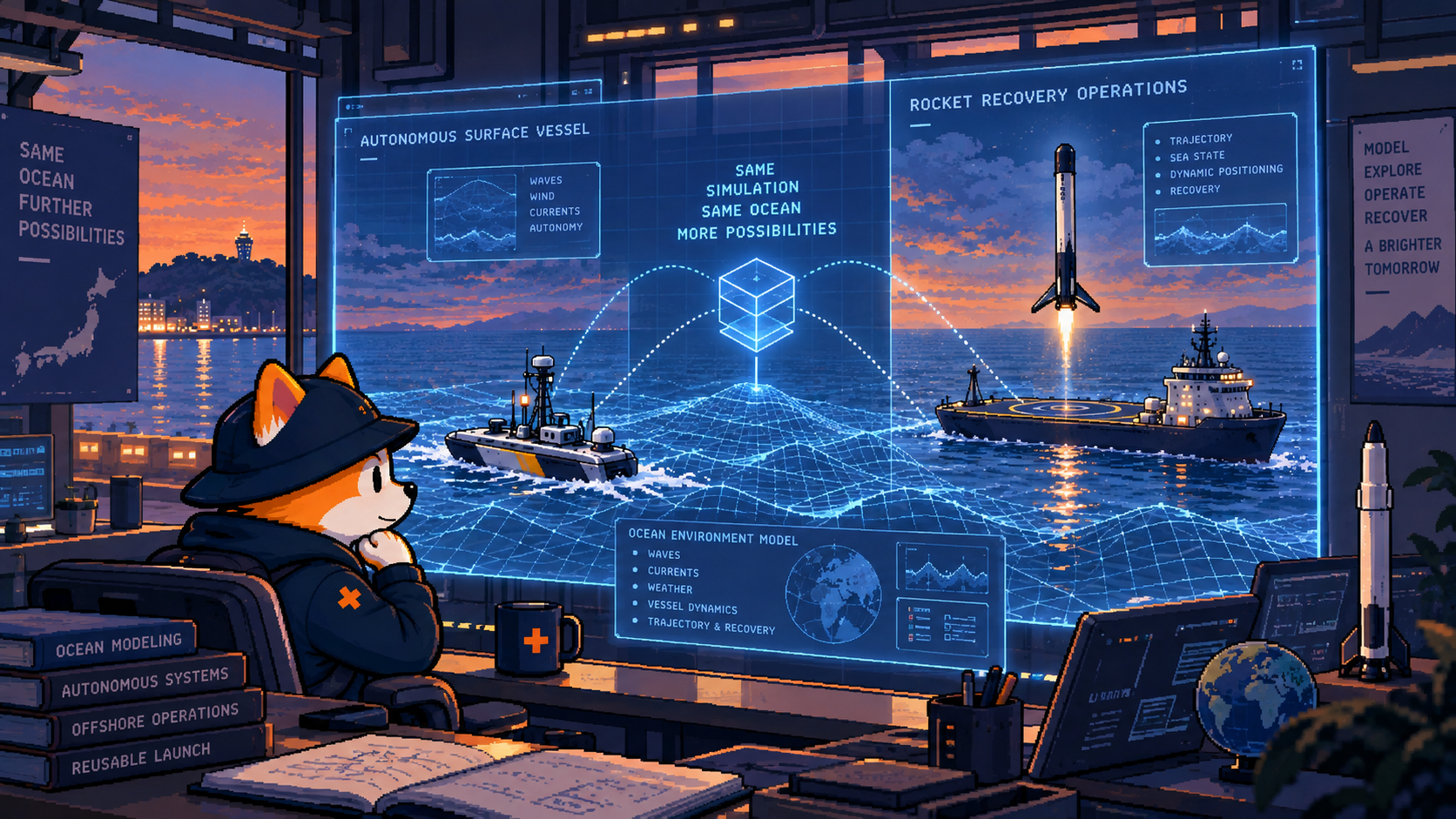
The rabbit hole: from underwater listening to falling rockets
There is one final connection in the Oceanic story that sounds unrelated until you look underneath it.
NYK is part of a JAXA Space Strategy Fund project developing technology for recovering reusable rockets offshore. Oceanic is involved too, although not because its three-metre USV is going to catch one.
In December 2025, NYK contracted Oceanic to develop integrated-simulation software and use it for scenario validation in the rocket-recovery project.
The two applications look very different, but underneath they share a similar problem: modelling moving vessels, changing sea conditions, positioning and offshore operations well enough to understand how a complicated operation will behave before trying it for real.
That overlaps surprisingly well with the tools Oceanic is building for autonomous boats.
Around that small boat, some unlikely pieces of Japanese engineering are beginning to meet: America’s Cup hydrodynamics, a Japanese shipyard, autonomous navigation, sonar and, somewhat unexpectedly, reusable rockets.
The next question is no longer whether a robot boat can patrol Kamakura overnight. It is what happens when Japan asks several of them to work together.
Sources & Further Reading
ATLA — Small-USV multistatic-sonar programme
The strongest source for the project’s objective, small-vessel constraints, two-to-ten-vessel modelling exercise and planned FY2026 sea demonstration.
ATLA — Contract result, 31 March 2026
Confirms Oceanic Constellations as contractor, the contract value and the scope of the technology concept demonstration.
Oceanic Constellations — August 2025 overnight operation
The company’s account of the 12-hour Kamakura test and its anti-poaching context.
Oceanic Constellations — September 2026 autonomy demonstration
Useful for understanding both what the launch-to-recovery sequence achieved and how human monitoring remained involved.
ACT’s explanation of the unusual hull design and its CFD simulation results.
Primary material on the effort to establish repeatable small-USV production and Oceanic hardware being assembled at Keihin Dock.
The clearest global reality check: a planned 55-vessel Bluebottle fleet, persistent surface and sub-surface surveillance and operational endurance measured in months.
NYK — Offshore reusable-rocket recovery
Explains Oceanic’s actual role in the JAXA-backed project: integrated marine simulation and scenario validation.