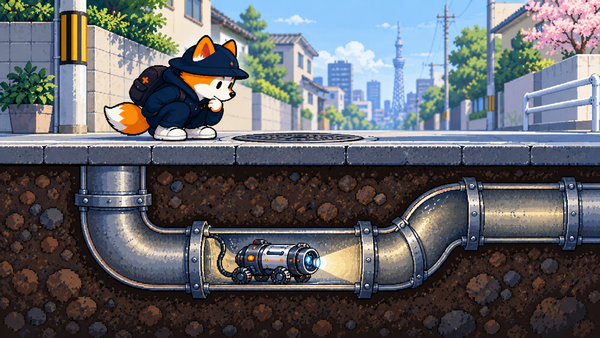
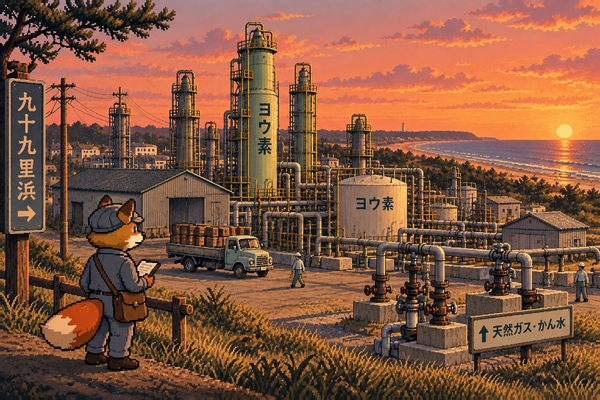
Why are three Japanese car-parts makers turning up in AI cooling?

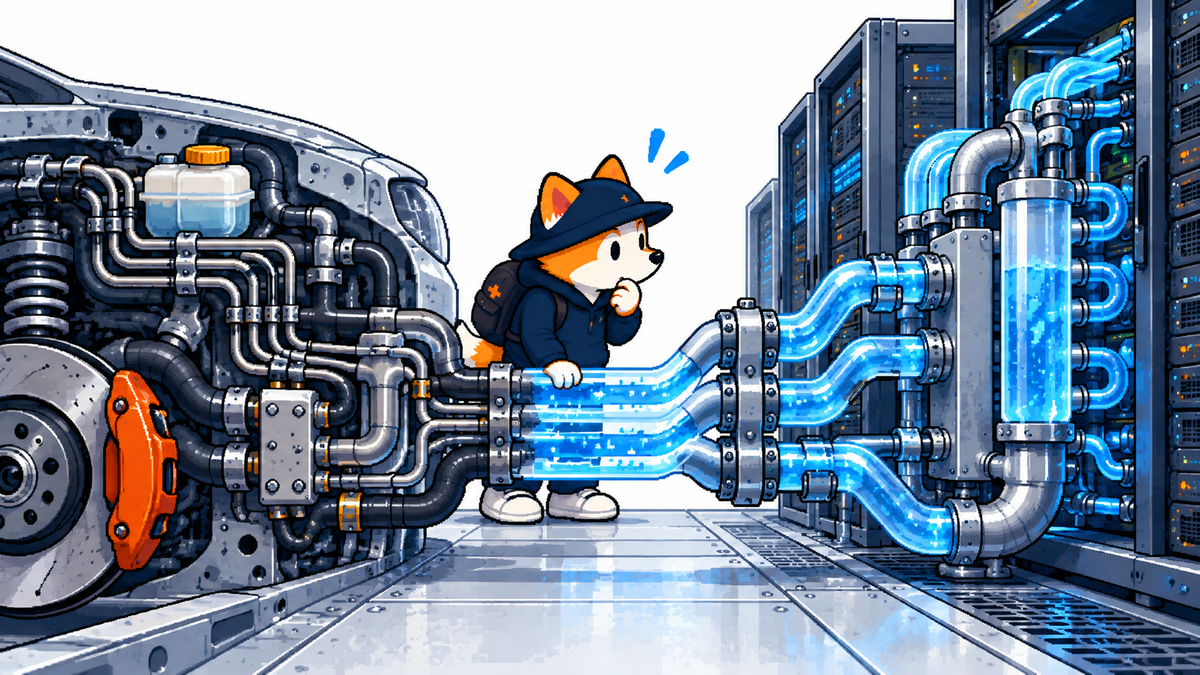
Sanoh wants data-centre cooling to become a ¥20–25 billion business by 2030. Nifco and Maruyasu are making their own moves. Behind all three is automotive know-how in pipes, fluid control and heat.
Sanoh Industrial wants its data-centre business to generate ¥20–25 billion a year by 2030. (Sanoh individual-investor briefing, February 2026)
For comparison, the Japanese automotive supplier's entire group generated ¥159.387 billion of sales in the year to March 2026. If Sanoh reached its data-centre target, it would be equivalent to roughly 13–16% of today's group revenue. (Sanoh FY2025 financial results)
The more revealing part came when an investor asked where that target came from.
President Genya Takeda said it was not based on Sanoh's current enquiries or orders. Management had started with expected growth in the data-centre market and worked backwards from the share it hopes to capture. More than half of the target is expected to come from overseas. (Logmi Finance transcript of Sanoh's November 2025 results briefing)
There is another wrinkle. Sanoh's Integrated Report 2021 already set a ¥25 billion FY2030 sales target for cooling products used in high-performance computing, or HPC. (Sanoh Integrated Report 2021)
That does not prove today's data-centre target is simply the old plan with a new label. It does show that Sanoh had assigned a very large number to non-automotive computer cooling before the generative-AI boom.
The commercial base is much smaller. Sanoh's February 2026 individual-investor briefing still expected only tens of millions of yen of data-centre sales for FY2025/26 and hundreds of millions in FY2026/27. Sanoh does not report the business as a separate financial segment, so the eventual FY2025/26 result is not visible as its own line item. (Sanoh individual-investor briefing)
That gap is the interesting part.
Why Sanoh thinks it belongs there
Sanoh's automotive business began with brake tubing in the 1960s and expanded into fuel, coolant and other vehicle piping, along with the connectors and manufacturing processes needed to join everything together. Many of these are safety-critical parts subject to strict quality requirements. (Sanoh automotive business; Sanoh history)
Some of that capability had already travelled somewhere unexpected before generative AI arrived.
In 2020, Sanoh publicly said its cooling-water resin piping had been adopted for Japan's Fugaku supercomputer. Its current water-cooling site is more specific: it now says manifolds, tubing and quick connectors supplied via Fujitsu were used in Fugaku. (Sanoh history; Sanoh water-cooling systems)
That change in description is worth preserving rather than smoothing over. Both versions come from Sanoh, and I have not found a Fujitsu or RIKEN source independently naming Sanoh as the supplier. The safest reading is therefore that the Fugaku connection is a well-established Sanoh claim, while the exact component scope comes from the company's later description.
Even with that caveat, the chronology matters.
Sanoh was moving automotive fluid-handling technology into high-performance computing years before the current AI boom.
AI has a plumbing problem
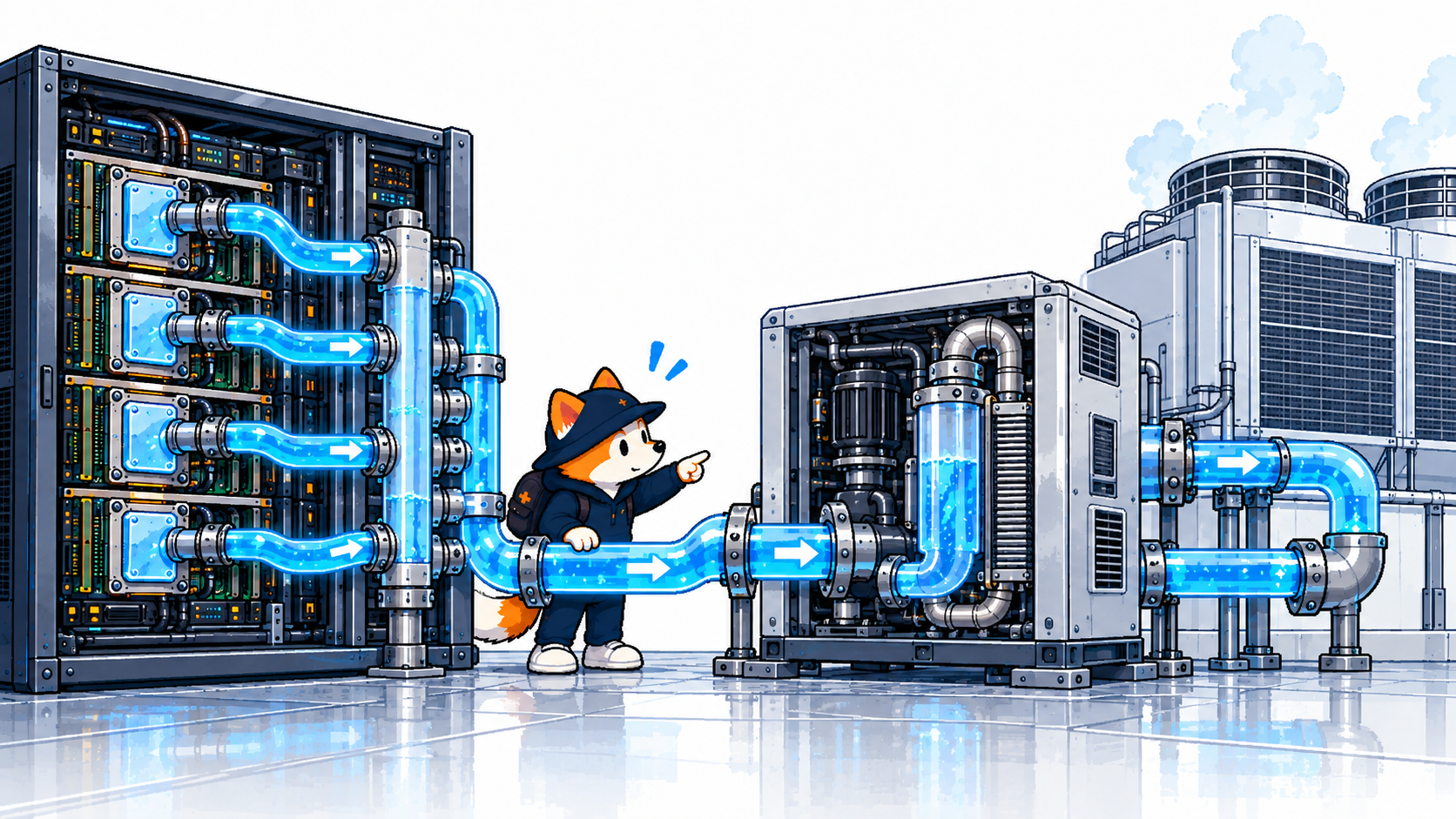
As processors become more powerful and racks become denser, air becomes a less attractive way to remove all of the heat. Direct liquid cooling carries coolant much closer to the chips.
A simplified route might run:
cold plate → tubing and connectors → rack manifold → coolant distribution unit → building cooling system
Every arrow hides physical hardware.
Equipment has to be installed and removed. Different suppliers' components have to fit together. Coolant has to move without excessive pressure loss. Connections have to survive maintenance. And ideally the water stays inside the plumbing.
NTT Data's Data Center Trial Field in Chiba is useful evidence that this is a genuine integration problem rather than something invented for a component supplier's sales pitch. NTT Data says liquid-cooling specifications differ between manufacturers and that safe installation and operation require coordination across servers, cooling equipment, facility piping and maintenance. (NTT Data)
Sanoh has participated in the facility. The company says that in some installations the precise arrangement between a data centre's main piping, coolant distribution units and rack manifolds is not settled until construction. More branches and connection points can also create more potential leak points. (Sanoh)
This is the unglamorous physical layer underneath the GPUs.
Sanoh is not the only car supplier looking at this
The broader question is whether Sanoh is simply one company with an unusual diversification idea.
It is not quite that simple.
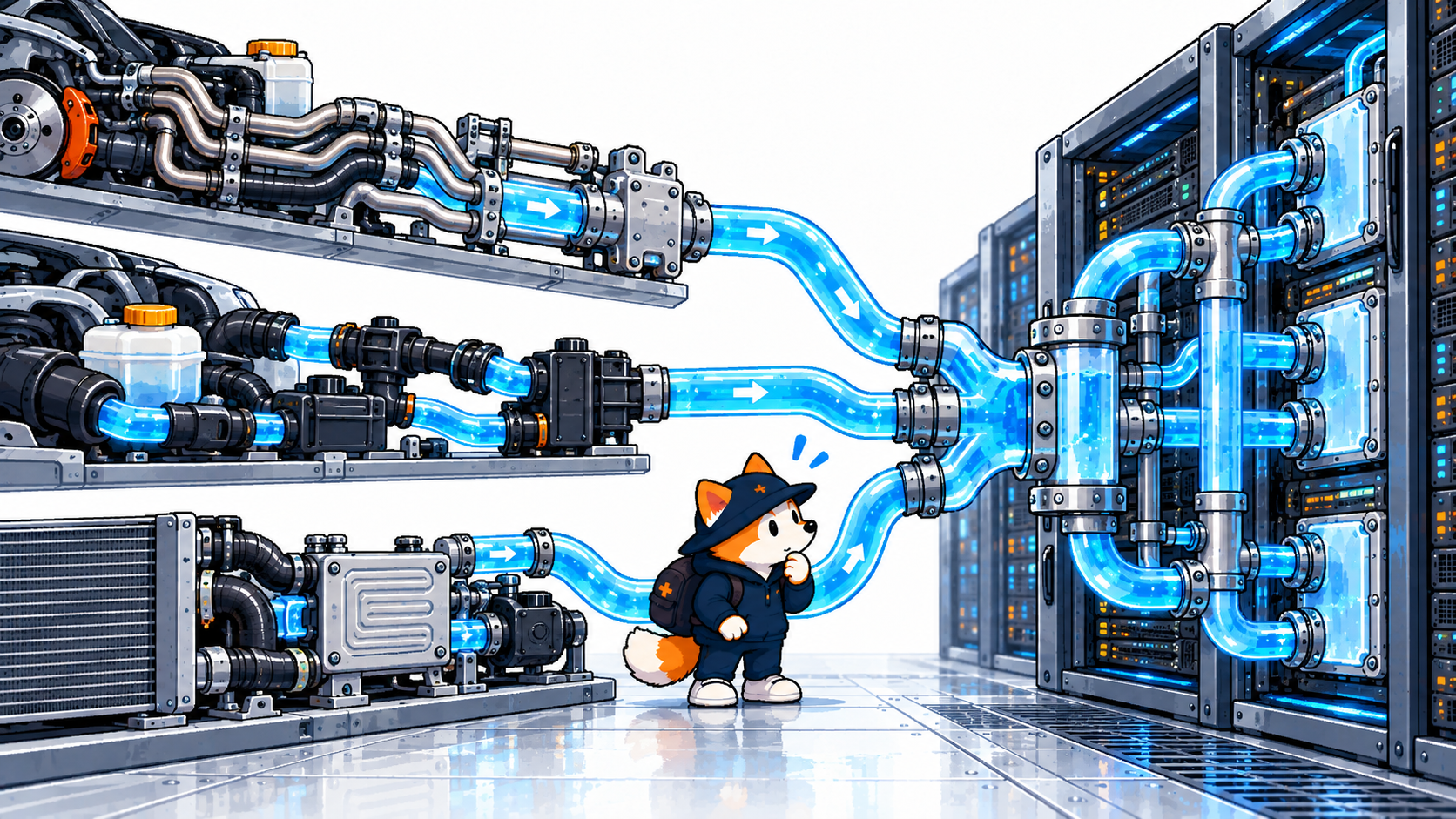
Nifco, another Japanese automotive-parts manufacturer, exhibited data-centre components for the first time in March 2026. Its announcement explicitly pointed to know-how accumulated in precision automotive parts around engines, fuel tanks and transmissions, and said it was using that experience to develop new components for data-centre cooling and related applications. (Nifco)
One of those products is a resin manifold for distributing cooling water. In June, Nifco supplied the manifold to Interop Tokyo's ShowNet, where it was used in a live water-cooled Open Rack V3 demonstration. (Nifco ShowNet result)
Then there is Maruyasu Industries.
Its automotive products include fuel and brake piping, coolant pipes and heat exchangers. At the same Data Center Japan event in March, Maruyasu showed a coolant distribution unit for water-cooled servers that was still under development. Its newer cold-plate material says the company is applying heat-transfer and fluid knowledge developed around heat exchangers, together with quality-control methods built through automotive manufacturing. (Maruyasu — Data Center Japan 2026; Maruyasu cold plate; Maruyasu automotive products)
That is enough to change the framing, but not enough to declare a sector-wide migration.
No equivalent public data-centre move was found in this pass at Usui International or Togo Seisakusho, despite relevant automotive piping and fastening capabilities. Nichirin already sells cooling piping outside vehicles, including for stationary energy-storage systems, but no public data-centre application was found. (Usui; Togo; Nichirin)
That is an absence-of-public-evidence finding, not proof that those companies are doing nothing privately.
For now, the safer conclusion is an early cluster: at least three Japanese automotive suppliers are trying to carry fluid, thermal and manufacturing know-how into liquid-cooled computing.
The field is already crowded
That does not mean Japanese automotive suppliers have discovered an empty market.
The Open Compute Project has a Universal Quick Disconnect, or UQD, specification designed around interchangeable, drip-resistant connectors for electronics cooling. Its marketplace already includes products from established suppliers including Stäubli, Parker and CEJN. (OCP UQD specification; Stäubli; Parker; CEJN)
So "doesn't leak" is closer to an entry requirement than a competitive moat.
Connectors also affect flow, pressure drop, servicing, footprint and compatibility. Sanoh still has to prove that its automotive manufacturing discipline translates into something customers value more than the alternatives.
Its own products show where it thinks it can contribute. The current range includes valve-equipped joints, resin tubing, manifolds, cooling plates and assembled piping. Sanoh also shows an example assembly combining its own joint and resin tube with a UQD rather than claiming to own the standard connector itself. (Sanoh water-cooling systems)
For the October 2026 OCP Global Summit, Sanoh announced that its manifold and piping assembly would be installed inside Nitto Kogyo's Open Rack V3-compliant rack at Murata's booth. That demonstrates integration into an ORV3 rack display. It does not establish that Sanoh itself has an OCP-recognised UQD product. (Sanoh)
The opportunity may therefore sit less in owning a standard interface and more in the hardware around it: custom manifolds, branches, tube assemblies and installation-friendly plumbing that still has to be designed and manufactured for particular systems.
That looks much closer to the work these companies already know.
The commercial base is still tiny
Sanoh has one named production customer, plus several unnamed domestic orders.
In September 2025 it disclosed an order from Japanese container-data-centre operator Getworks for a water-cooling module package including stainless-steel manifolds, resin piping, ball-valve joints and connectors. Sanoh said the order's impact on group results for the year to March 2026 would be minor. The same release said it had also received multiple ball-valve-joint orders from several domestic companies. (Sanoh / Getworks order)
Sanoh's February 2026 briefing gave a little more detail: two unnamed customers had ordered two and four sets of ball-valve joints, and the company said multiple customers had placed multiple-quantity orders. Some of that demand also extends beyond data-centre applications. (Sanoh individual-investor briefing)
The larger opportunities remain much less mature. Sanoh's May 2026 results briefing said it had prototype orders from domestic and overseas server and water-cooling-module makers, with those projects still mainly in the prototype and evaluation phase rather than mass production. (Sanoh FY2025 results briefing)
Meanwhile, the formal financial reporting still does not give data-centre cooling its own segment line. The clearest public scale markers remain management's expectation of tens of millions of yen, then hundreds of millions, followed by the much larger ¥20–25 billion FY2030 ambition.
There is an enormous amount of execution hidden between those numbers.
That is precisely why this is worth noticing now rather than after the answer is obvious.
The rabbit hole: making a thicker pipe by rubbing a hole into it
One of the nicest details sits inside Sanoh's manifold.
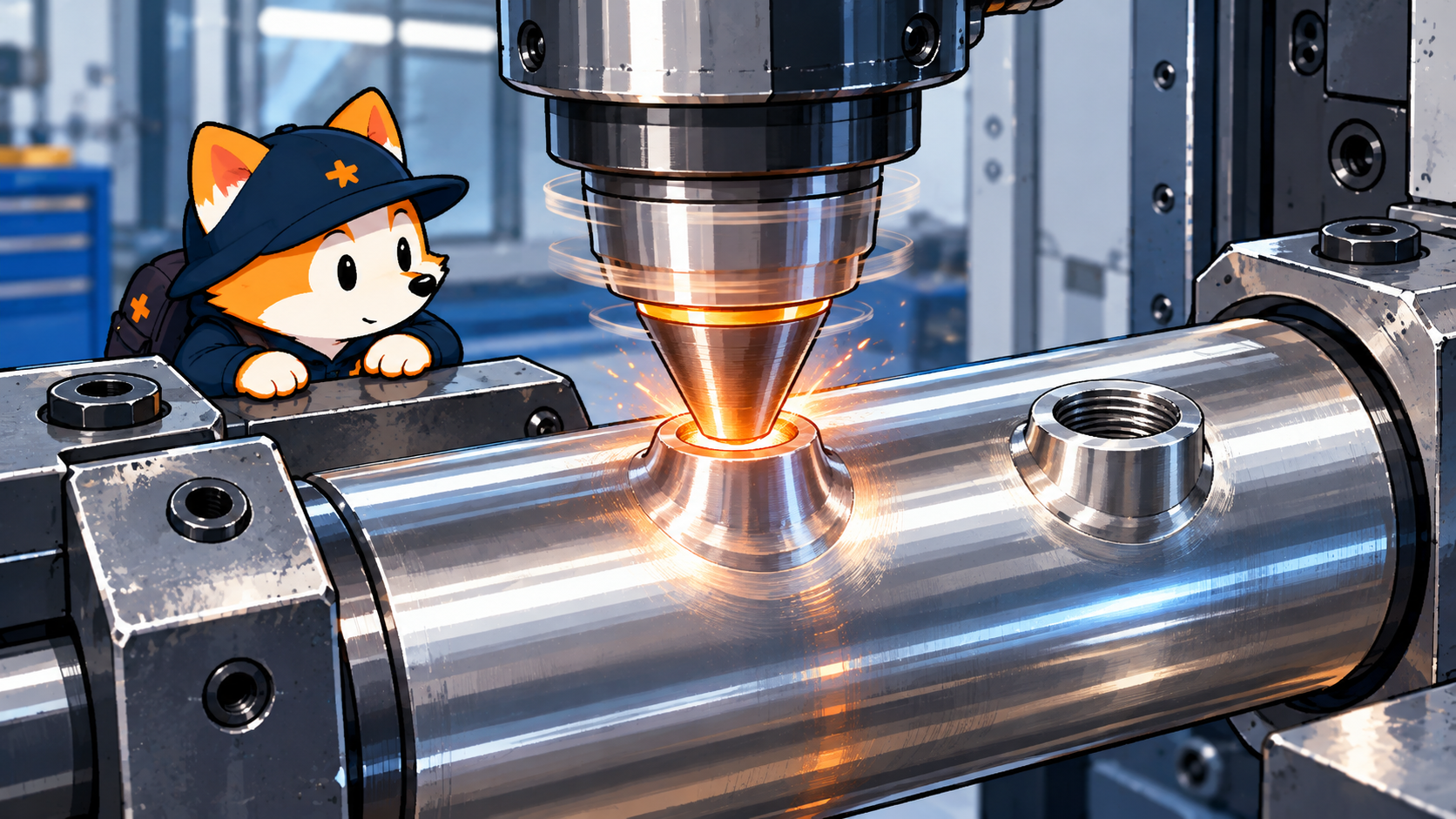
A manifold takes one coolant flow and divides it among multiple branches. Those branches need strong threaded connection points, but the stainless-steel tube itself can be relatively thin.
Sanoh describes a manufacturing process in which a rapidly rotating tool is pushed into the tube. Friction heats and softens the metal locally. Instead of simply cutting material away, the tool displaces it into a thicker sleeve around the new hole.
A thread can then be formed directly in that sleeve.
Sanoh says this removes the need to weld on a separate fitting, reducing the number of parts, weight and manufacturing cost. (Sanoh manifold technology)
The underlying process is not a Sanoh invention. It is generally known as friction drilling, thermal drilling or flow drilling, and technical literature describes it as an established chipless hole-making process with a long research history. (Eliseev & Kolubaev — Friction drilling: a review)
That almost makes the detail better.
AI infrastructure does not consist only of new technology. New computational problems can create demand for very old manufacturing knowledge.
Friction drilling is a good example: an established way of shaping a stronger connection point in thin metal has found a new place inside the plumbing around increasingly powerful computers.
Sources & Further Reading
Sanoh Industrial — strategy and investor Q&A
The 2021 report shows that Sanoh had already targeted ¥25 billion of FY2030 sales from HPC cooling products before the current AI boom. Sanoh's February 2026 investor deck gives the current ¥20–25 billion target and near-term scale markers; the published Logmi Finance transcript contains Takeda's explanation that the target is not based on current enquiries or orders.
https://www.sanoh.com/wp-content/uploads/2024/12/2021report_jp.pdf
https://pdf.irpocket.com/C6584/doF3/aZoM/DQop.pdf
https://finance.logmi.jp/articles/383228
https://pdf.irpocket.com/C6584/WUpy/P8qq/WDbe.pdf
Sanoh Industrial — automotive history and water-cooling systems
Useful for the brake/fuel/coolant piping lineage and for seeing the change from the 2020 Fugaku wording, "cooling-water resin piping", to the company's current description of manifolds, tubing and quick connectors.
https://www.sanoh.com/corporate/history
https://thermal-solution.sanoh.com/
Sanoh Industrial — orders and current pipeline
The September 2025 disclosure confirms the named Getworks production order and additional domestic ball-valve-joint orders. The February and May 2026 briefing decks show the near-term sales scale and that larger domestic/overseas opportunities remain mainly in prototype and evaluation.
https://pdf.irpocket.com/C6584/CiMB/GWUw/kDiO.pdf
https://pdf.irpocket.com/C6584/doF3/aZoM/DQop.pdf
https://pdf.irpocket.com/C6584/fcDL/FW3G/H1GP.pdf
NTT Data — Data Center Trial Field
Independent context for why liquid cooling creates practical integration problems across servers, cooling equipment, facility piping, construction and maintenance.
https://www.nttdata.com/global/ja/news/topics/2024/112100
Nifco — data-centre components and ShowNet
The strongest peer evidence that Sanoh is not a sample of one: Nifco explicitly links its new data-centre components to automotive know-how and has demonstrated its resin water-cooling manifold in an ORV3 rack.
https://www.nifco.com/products/news/detail/m3k5br0000000dmt.html
https://www.nifco.com/products/news/detail/20260617.html
Maruyasu Industries — CDU and cold-plate development
A second automotive-supplier parallel, covering a CDU under development and the transfer of heat-exchanger, fluid and automotive-manufacturing know-how into cold plates.
https://www.maruyasu.co.jp/topics/202603/271934/
https://coolingplate.maruyasu.co.jp/
Open Compute Project — UQD specification and marketplace
The global reality check: liquid-cooling connector interfaces are already being standardised and supplied by established specialists.
https://www.opencompute.org/documents/ocp-universal-quick-disconnect-uqd-specification-rev-1-0-2-pdf
https://www.opencompute.org/products/543/staubli-universal-quick-disconnect-uqd
https://www.opencompute.org/ai-marketplace/products/443/parker-uqd-series-universal-quick-disconnect-couplings
https://www.opencompute.org/marketplace/facilities-physical-infrastructure/cejn-universal-quick-disconnect-uqd/
Sanoh Industrial / Eliseev & Kolubaev — friction drilling
Sanoh's explanation of its manifold process, followed by independent technical background showing that friction drilling itself is an established manufacturing method.
https://www.sanoh.com/6969
https://doi.org/10.1007/s00170-021-07544-y