The cable beneath a floating wind turbine could become its own sensor
A Japanese project aims to embed fibre-optic sensors in the steel cables anchoring floating wind turbines, turning mooring lines into monitoring systems.

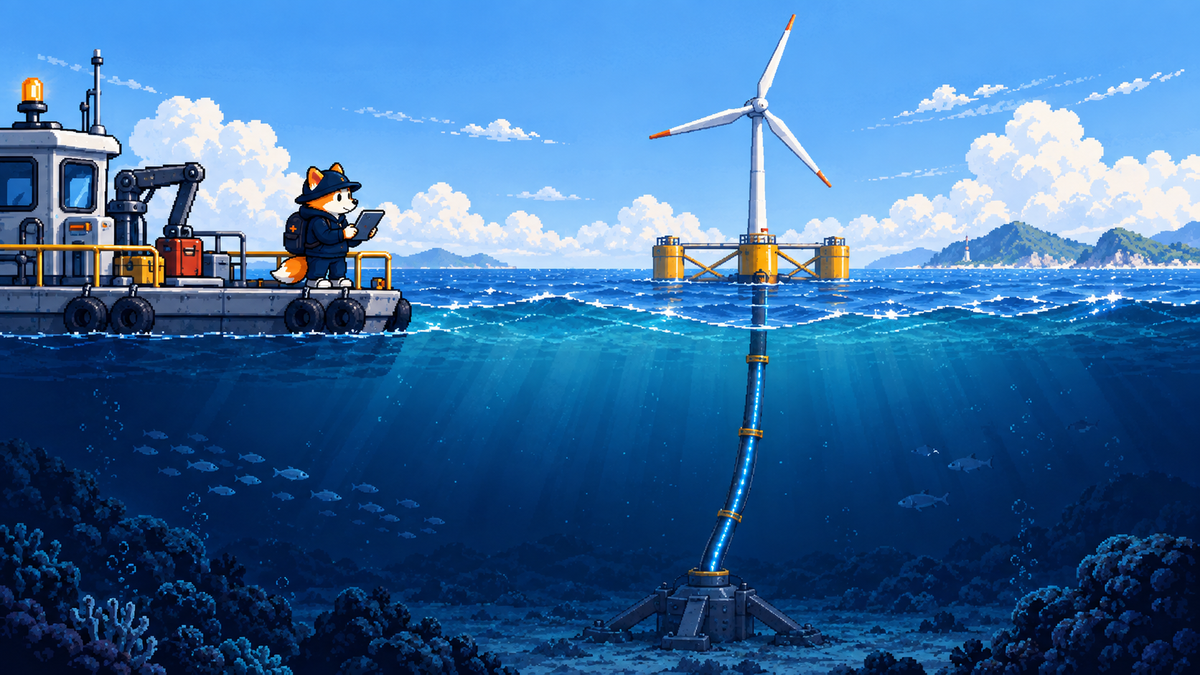
Neubrex has spent more than two decades learning how to read tiny physical changes through optical fibre. Now it wants to put that fibre inside the steel cable holding a floating wind turbine to the seabed.
A floating wind turbine is only floating in a limited sense.
Its platform moves with the sea, but mooring lines run down to anchors on the seabed and stop the whole structure drifting away. Those lines spend their lives being pulled by wind, waves and currents while sitting in salt water.
Their condition matters.
Floating wind is still too young to provide decades of failure data. A 2026 review focused on floating offshore wind in Japan says there is not yet applicable failure data for floating-wind mooring lines. It therefore looks to decades of offshore oil-and-gas experience, where repeated mooring-line failures have been reported and fatigue, corrosion and wear emerge as major causes.
Japan has a particular reason to care about floating wind. Compared with the broad shallow seas around much of Europe, Japan has steep bathymetry and complex seabed conditions. METI says expanding floating wind is indispensable if the country is to push offshore wind into deeper water.
That makes the cable underneath the turbine rather more important than it first appears.
On 17 August 2026, NEDO selected a project led by KOBELCO WIRE COMPANY, LTD., with Osaka University and Kobe-based Neubrex, to develop a floating-wind mooring system combining highly corrosion-resistant steel cable with distributed fibre-optic sensing. Neubrex is participating as a subcontractor, with KOBELCO WIRE as the lead implementing organisation and Osaka University as the co-implementing organisation.
The basic idea is wonderfully physical.
Put optical fibre into the cable carrying the load, then use changes in the light travelling through that fibre to work out what is happening along the mooring line. KOBELCO WIRE's own project diagram explicitly shows a concept for a mooring line with a built-in optical-fibre sensor.
The cable would not only hold the turbine in place.
It would also help monitor itself.
A 25-person company that has been listening to glass for decades
Neubrex did not appear because floating wind suddenly became fashionable.
The company was established in Kobe in 2002 as a spin-out from what its own history describes only as a major electronics manufacturer. Its president is Kinzo Kishida, and Japanese government workplace data currently lists 25 employees.
That is a small organisation for a technology intended to monitor very large things.
Neubrex's first commercial NEUBRESCOPE instrument appeared in 2005. In 2011 it released the NBX-7000, which the company says enabled high-precision Rayleigh measurement and hybrid strain-and-temperature separation. It later expanded into distributed acoustic sensing, established service operations in the United States and Switzerland, and entered offshore wind through a NEDO project in 2023. The chronology is laid out in Neubrex's company history.
The underlying idea starts with something optical fibre normally tries to ignore.
Not all the light sent through a fibre reaches the other end. Tiny variations in the glass cause a small amount to scatter backwards. Stretch part of the fibre, change its temperature or vibrate it, and the returned light changes.
Measure those changes carefully enough and the fibre itself becomes the sensor.
Instead of installing separate electronic strain gauges every few metres, one strand of glass can potentially provide measurements from huge numbers of positions along its length.
Neubrex has spent more than two decades trying to make those measurements increasingly precise and useful. Its systems now cover applications ranging from civil infrastructure and energy facilities to railways and underground sensing.
That sounds ideal for a mooring line disappearing into the sea.
But there is a complication.
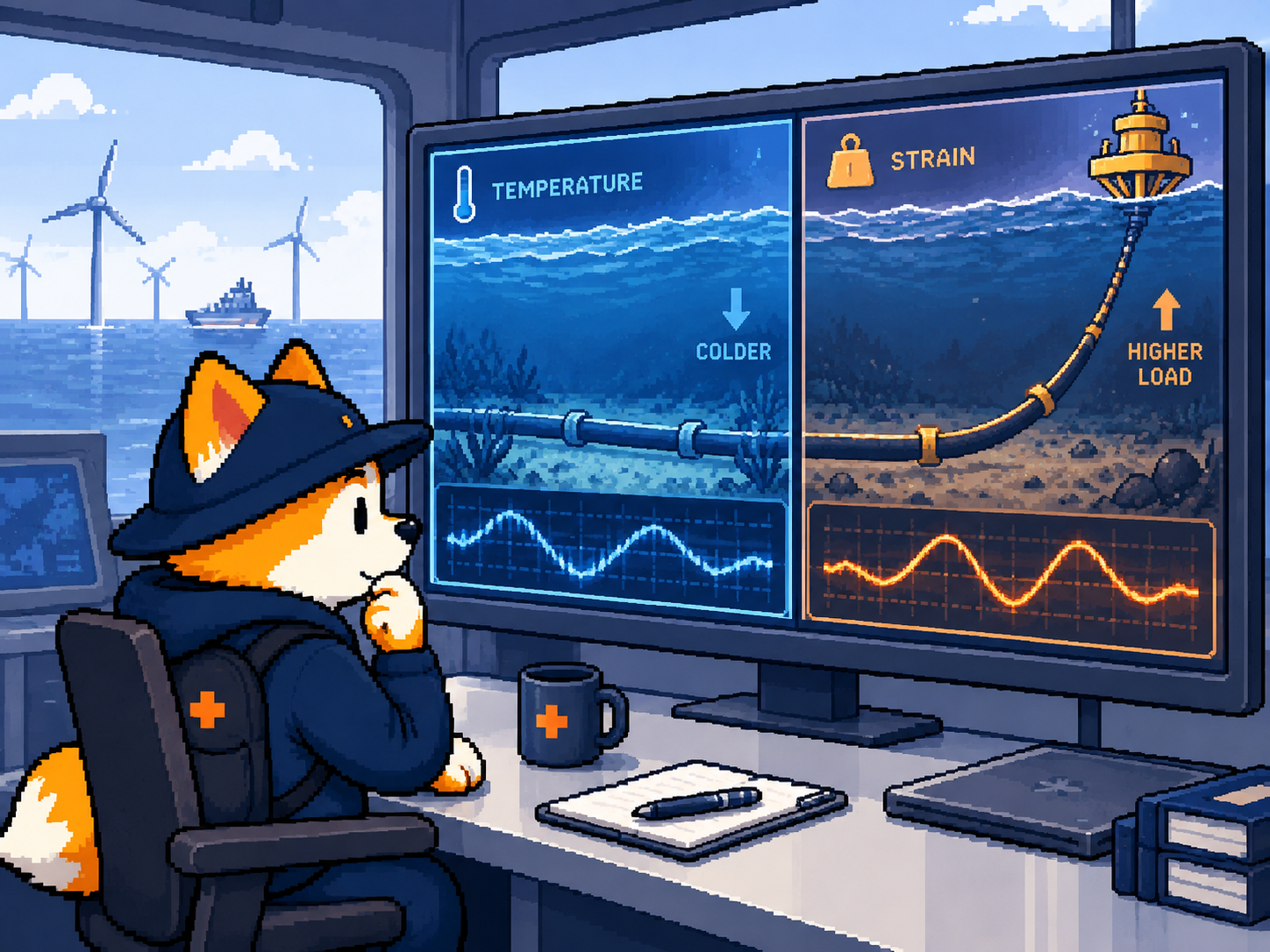
Is it stretching, or is it just colder?
Suppose part of an optical fibre produces a different signal today than it did yesterday.
Perhaps that section of the mooring cable is experiencing more strain.
Or perhaps the water around it is colder.
Both temperature and mechanical strain affect measurements based on scattered light. If the eventual purpose is to decide whether an enormous structural cable is deteriorating, confusing those two effects would be fairly unhelpful.
One of Neubrex's longstanding technical approaches is to measure two different kinds of scattering: Rayleigh scattering and Brillouin scattering.
They respond differently to strain and temperature. By measuring both, the effects can be separated and the two unknowns estimated from the same fibre.
In simple terms, one measurement leaves you with a problem containing two possible explanations.
Take a second measurement that behaves differently, and you have another piece of information with which to untangle them.
Neubrex says its NBX-7000 introduced hybrid strain-and-temperature separation in 2011. In 2013, Kishida and colleagues published a detailed description of the hybrid Brillouin-Rayleigh approach in Photonic Sensors, including the equations used to derive strain and temperature from the combined measurements. The paper is open access.
That capability looks relevant to structural sensing in an environment where temperature is hardly constant.
There is an important limit to what we can say, however.
The public material for the new mooring project does not say that this exact hybrid measurement method will be used. Neubrex says it will develop fibre-optic monitoring and integrity-assessment technology for the cable, but it does not specify the final sensing architecture.
So the technique helps explain what Neubrex knows how to do.
It should not yet be presented as the confirmed solution inside this particular cable.
The other company comes from bridges
The glass is only half the project.
The steel comes from a very different industrial history.
KOBELCO WIRE was established in 1954 after being spun out of Kobe Steel. Its own company history says its steel goes into large bridges, highways, Shinkansen lines, buildings and other infrastructure.
Among its products is semi-parallel wire cable, or SPWC.
Rather than behaving like a conventional twisted wire rope, the structural wires run almost parallel to one another inside the cable. The technology comes out of the company's long experience with large civil structures.
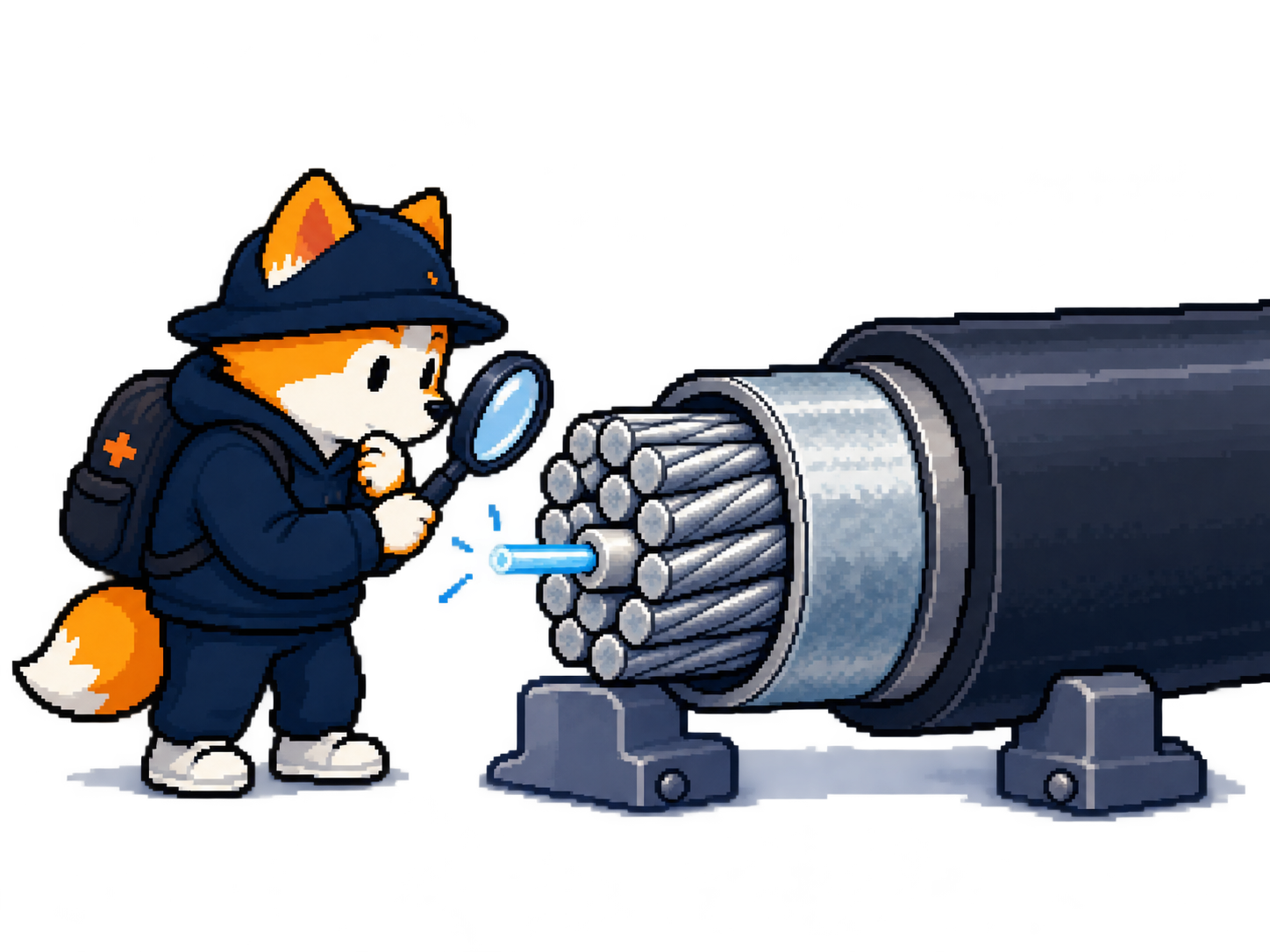
A bridge cable, though, has an advantage over an offshore mooring line.
It does not normally spend twenty years underwater.
For marine use, KOBELCO WIRE developed a highly corrosion-resistant version. Galvanised structural steel wires are surrounded by additional zinc wire and covered in polyethylene.
The extra zinc acts sacrificially.
If seawater penetrates the outer protection, the zinc is intended to corrode in preference to the load-bearing steel underneath. KOBELCO WIRE says the cable is designed on the assumption of more than 20 years of maintenance-free underwater use.
That is the manufacturer's design objective, not evidence from 20 years beneath an operating floating wind turbine.
The underlying cable has nevertheless passed a meaningful industrial milestone.
On 30 March 2026, ClassNK announced manufacturing-procedure and type approvals for KOBELCO WIRE's high-corrosion-resistant SPWC. ClassNK is Japan's ship classification society and also conducts classification surveys for floating offshore wind structures.
Those approvals are evidence that the underlying cable and its manufacturing process have progressed well beyond a research concept.
What they do not validate is the complete future version with Neubrex's sensing integrated into it.
That is what the new project is trying to develop.
Measuring something is not the same as knowing whether it is broken
Putting fibre into the cable produces the clever diagram.
The harder part comes afterwards.
A mooring line does not live under one constant load. The turbine moves. Waves come and go. Currents change. Storms arrive. The steel bends, stretches, corrodes and accumulates fatigue.
A useful monitoring system therefore has to do more than report:
"There is strain here."
It has to establish what normal behaviour looks like, recognise when that behaviour is changing and eventually provide enough confidence for somebody to make a maintenance decision.
The sensing hardware has to survive too.
The steel cable is intended to remain underwater for decades. The fibre and its protective structure will be repeatedly loaded alongside it, while connections and interrogation equipment introduce additional failure points.
Then there is the amount of information.
Distributed fibre sensing can generate extremely detailed data. More data does not automatically create a diagnosis. The system has to separate ordinary environmental variation from deterioration without producing so many false warnings that operators stop trusting it.
This matters because the alternative is not "no inspection."
Floating-wind maintenance research already assumes the use of remotely operated vehicles to inspect moorings. One O&M study models annual ROV visual surveys of all moorings and more detailed periodic surveys. Continuous fibre sensing would not eliminate physical inspection, but it could potentially provide information between those inspections and help decide where closer attention is needed.
Whether it actually reduces vessel time, downtime or maintenance cost is something the projects still have to demonstrate.
I found no public evidence that a complete Neubrex/KOBELCO WIRE sensing-integrated mooring line is already operating beneath a commercial floating wind turbine.
For now, this remains a development project.
Neubrex wants to watch the rest of the turbine too
The mooring project makes more sense when placed beside another Neubrex announcement six weeks earlier.
On 3 July 2026, Neubrex announced that it had been selected for a separate three-year NEDO Green Innovation Fund project to develop and demonstrate continuous distributed fibre monitoring across offshore wind turbines.
One target is lightning damage.
After a turbine is struck, operators need to understand what happened before deciding whether it can safely return to service. Neubrex wants fibre sensing to help make that assessment faster.
Another target is much less dramatic: bolts.
Large turbines contain many bolted connections whose condition matters over time. Neubrex plans to investigate long-distance monitoring of bolt fastening integrity, and the project explicitly includes demonstration testing on an operating wind turbine.
None of this means Japan has invented fibre monitoring for wind turbines.
Researchers overseas are already doing related work. A team at UC Berkeley used two Rayleigh-based distributed fibre-sensing technologies on a full-scale wind-turbine tower and tested configurations with deliberately loosened flange bolts.
There are commercial offshore applications too. In France, AP Sensing says its distributed temperature and acoustic systems are monitoring export cables serving the Fécamp, Saint-Brieuc and Gruissan offshore wind projects. Gruissan is a floating-wind pilot whose connection includes a 24-kilometre submarine cable.
French company FEBUS Optics is also developing distributed fibre monitoring for dynamic cables on offshore assets including floating wind turbines.
So Neubrex is operating in an international field.
What makes the Japanese work interesting is the particular industrial combination now forming around it.
A 25-person Kobe company that has spent more than twenty years trying to extract information from scattered light is being paired with a steel-cable manufacturer whose expertise comes from bridges and heavy civil infrastructure.
One project wants to monitor the turbine above the water.
Another wants to put sensing into the cable disappearing underneath it.
Optical fibre begins to look less like an individual sensor and more like a distributed nervous system running through a large physical machine.
What would change the story?
The first thing to watch is scale.
A full-sized sensing-integrated mooring cable going into long-duration marine testing would matter more than another laboratory measurement.
Putting one beneath an actual floating wind turbine would matter considerably more.
Then comes the real test: whether the information is reliable enough to change what an operator does.
Can the system identify deterioration early enough to matter?
Does the sensing survive years of repeated loading?
Can operators use it to reduce unnecessary inspection or downtime?
Can the software distinguish something that requires attention from the normal violence of the sea?
Those answers would turn an interesting monitoring technology into infrastructure.
The separate Neubrex wind-turbine project may provide useful evidence first because it explicitly includes demonstration on an operating wind turbine.
For now there is still a large gap between a piece of glass capable of measuring extraordinarily small physical changes and a wind turbine that can tell somebody when it needs fixing.
Neubrex is trying to close it.
The rabbit hole: listening for a tunnel with a piece of glass
One of Neubrex's strangest experiments this year had nothing to do with wind.
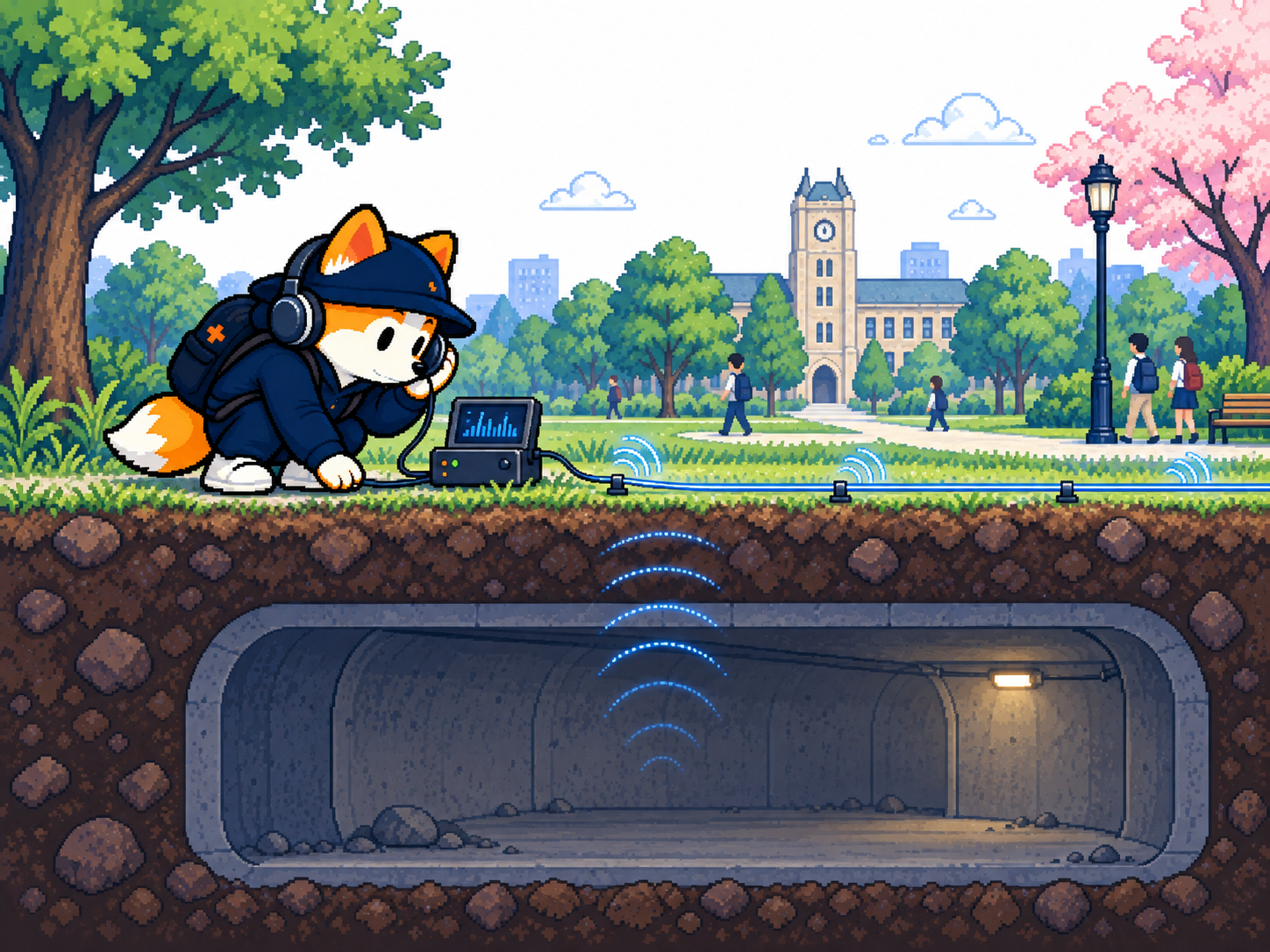
On 30 July 2026, Neubrex and Kobe University reported a preliminary experiment in which optical fibre was laid across the ground above a known underground tunnel.
Then they listened.
They did not generate a special seismic pulse.
Cars, people, rain, wind and other everyday activity continuously create tiny vibrations in the ground. Neubrex used distributed acoustic sensing to record those background vibrations for nine hours overnight.
The tunnel was roughly two metres wide and two metres high, about ten metres beneath the university campus.
By analysing how the vibrations behaved at different positions, the researchers identified an anomalous region corresponding to the tunnel's position and width. Using the measured wave behaviour, they estimated its depth at 9.3 metres, close to the known depth of about ten metres.
The team also tested whether cheaper fibre could work.
Neubrex's dedicated sensing cable produced useful measurements, but so did a simple coated optical fibre.
A telecommunications dark fibre they tested was less successful. Its signal deteriorated significantly and Neubrex concluded that it was unsuitable for this particular measurement method.
That negative result is useful.
Not every piece of existing fibre infrastructure can simply be turned into a sensor by plugging in the right box.
The tunnel work is preliminary. Neubrex and Kobe University still want further field validation before using the approach to investigate things such as underground cavities, ageing sewer pipes or loosened ground.
But the experiment gives a good sense of why the underlying technology keeps appearing in such different places.
A strand of glass designed to carry information can also become the thing gathering it.
On one day it is lying across the ground listening for a tunnel.
On another, somebody wants to put it inside the cable holding a wind turbine to the bottom of the sea.
Sources & Further Reading
Neubrex — Floating-wind mooring project
The company's primary English announcement for the August 2026 project. It confirms Neubrex's subcontractor role, the project structure and the intended development of fibre-optic mooring monitoring and integrity assessment.
KOBELCO WIRE — Project release and concept diagram
Useful for the project's physical concept. The diagram explicitly describes structural study of a mooring line with a built-in optical-fibre sensor.
Neubrex — Company history
The best source for the 2002 spin-out, the NBX-6000 and NBX-7000 chronology, expansion into distributed acoustic sensing and the company's move into offshore wind.
Photonic Sensors — Hybrid Brillouin-Rayleigh sensing
Kishida and colleagues' open-access technical paper explaining the combined strain-and-temperature measurement problem and the hybrid approach.
KOBELCO WIRE — High-corrosion-resistant SPWC
The company's explanation of the zinc, galvanised steel and polyethylene construction and its 20-plus-year maintenance-free design assumption. Those performance statements should be read as manufacturer claims. The shinko-wire.co.jp domain reflects the company's former English name; it changed its English corporate name to KOBELCO WIRE COMPANY, LTD. in 2021.
ClassNK — SPWC approvals
Independent confirmation of the March 2026 manufacturing-procedure and type approvals for the high-corrosion-resistant cable.
Wind Energy Science — Floating offshore wind in Japan
A useful 2026 review of Japan's floating-wind engineering challenges, including the lack of mature floating-wind mooring-failure data and the historical offshore experience with fatigue, corrosion and wear.
Neubrex / Kobe University — Underground tunnel experiment
Primary source for The rabbit hole, including the nine-hour ambient-vibration measurement, the 9.3-metre depth estimate, the successful coated-fibre test and the unsuccessful dark-fibre test.